
Strategic Impacts™ Framework > Start Here > The Strategic Impacts™ Framework
The Strategic Impacts Framework: An Introduction
~3 min read | March 2026
For more than twenty years, additive manufacturing has been explained through its applications—what it can produce, one impressive example at a time. That has demonstrated capability without ever explaining consequence, leaving the technology understood as a collection of exceptions rather than a structural shift in how organizations operate. A structural framing has been missing: an explanatory account of how additive manufacturing changes the organizations that adopt it.
The Strategic Impacts™ Framework exists to address that gap.
What This Framework Is
This framework introduces a structural explanation of additive manufacturing—one that organizes what has been observed for 20+ years into a coherent explanatory structure—applying organization to what we already see.
A structure that when presented will feel almost obvious.
This framework does not add to the plethora of impressive use case examples; it asks a different question:
Why do the same patterns appear repeatedly, even as technologies, industries, and applications change?
This framework examines why additive manufacturing so often show up in low-volume or varying-demand environments, in spare and legacy parts, and in situations where timing and location matter more than unit cost—yet struggles to find a coherent, enterprise-level framing.
These are signals—not coincidences.
How the Framework Is Structured
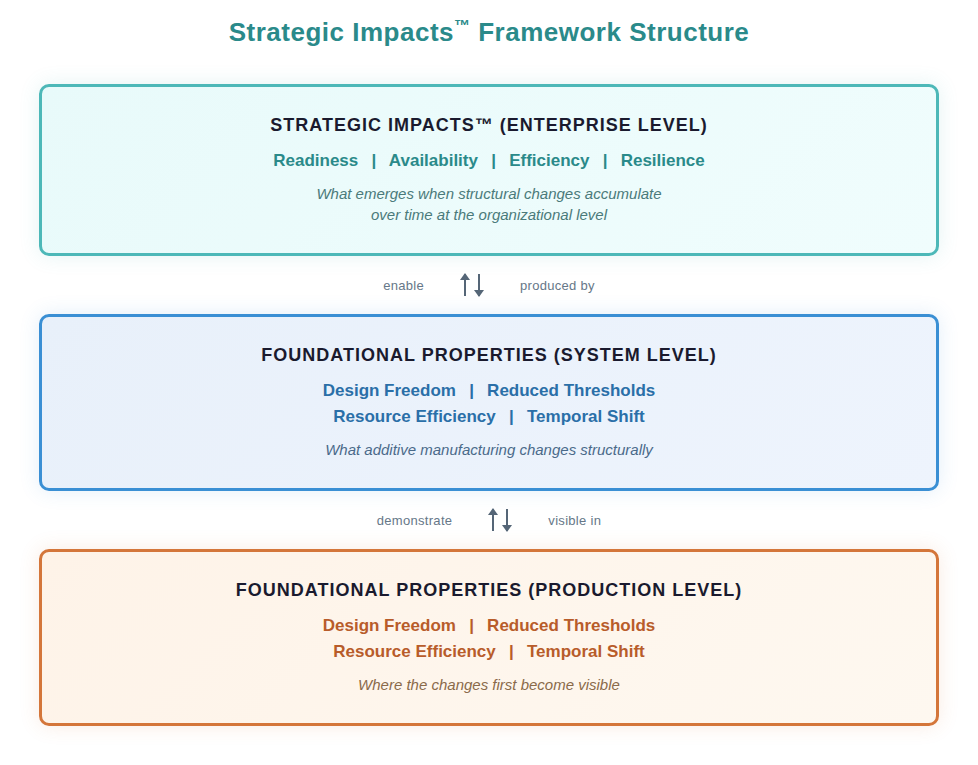
The Strategic Impacts™ Framework operates at three levels:
At the production level, four Foundational Properties describe what additive manufacturing changes structurally: Design Freedom, Reduced Thresholds, Resource Efficiency, and Temporal Shift. These properties explain why and how familiar outcomes occur repeatedly.
At the system level, those same four properties are viewed from a wider organizational distance, where their effects are less tangible but more consequential for how organizations design, supply and operate.
At the enterprise level, when those structural changes accumulate, they merge as four Strategic Impacts: Readiness, Availability, Efficiency, and Resilience. These are not benefits to be gained, but organizational conditions that emerge when additive manufacturing is integrated rather than exceptional.
This framework does not prescribe if or how additive manufacturing should be used, nor does it guarantee advantage. It does provide a lens for interpretation and understanding—a way to see additive manufacturing not as a set of disparate tools, but as an influence on organizational behavior.
What This Framework Is Not
This framework does not propose when or where additive manufacturing should be used. It does not offer a roadmap, checklists, or next steps. It does not attempt to prove value through use case studies or ROI comparisons.
Those are important conversations—and best served elsewhere. This framework operates at a different level. It explains behavior, not merit.
Who This Framework Is For
The framework is built for anyone trying to understand additive manufacturing as more than a set of tools, and it meets different readers at different levels and with varying stakes in additive manufacturing outcomes. This includes manufacturing leaders, supply chain strategists, sustainability professionals, and policy stakeholders. It also includes the engineers and teams advancing additive manufacturing within their organizations—who often see the potential most clearly but lack the language to connect it to strategic decisions—and the technology developers and providers whose ability to articulate consequence, not just capability, determines whether the industry moves beyond its current ceiling.
How to Read This Work
The framework can be entered at different points. See the Reader’s Guide for navigation options. Readers focused on strategic implications may choose to go directly to the Strategic Impacts Series.
Why This Clarity Matters
The Strategic Impacts Framework provides that missing layer. It offers a way to explain additive manufacturing succinctly, without hype, and without relying on case studies or exceptions.
It does not sell additive manufacturing—it explains it.