
Strategic Impacts™ Framework > Foundational Properties: Production Lens > Article 1 of 5
New to this work? Begin with the The Strategic Impacts Framework: An Introduction | Reader’s Guide
Series Progress ●○○○○
The Foundational Properties at a Production Level
Why Certain Outcomes Repeatedly Occur
~7 min read | March 2026
This article introduces the Foundational Properties of Additive Manufacturing as they operate at the production level. Readers new to this framework may wish to begin with the Making Sense of What We Already See article or the System Level series.
Commercial additive manufacturing has spent 20+ years proving that it works. Refinement and expansion of capabilities will continue. This is not in question.
The sector is awash in active-use applications, cool parts, and headlines showcasing recognizable brands integrating additively produced components. Lightweighted components that improve performance without sacrificing strength. Consolidated parts that replace complex assemblies. Components redesigned to perform better, last longer, and run cooler. Parts that are produced at the point of need in hospitals, on oil rigs, and at the front lines of conflict.
These outcomes are real. They are repeatable. And by now they are widely understood and celebrated within the additive manufacturing community.
They are also poorly explained.
Technical knowledge is not lacking. The additive manufacturing sector has accumulated evidence, deep process expertise, and growing commercial experience. What has not emerged until now is a structural explanation for why additive manufacturing generates recurring patterns of behavior—independent of specific applications, industries, or examples. This framework provides that explanation.
Despite years of technical progress and growing commercial acceptance and integration, the additive manufacturing community has struggled to answer a deceptively simple question in a succinct and clarifying way, without relying on use cases or dense technical detail:
What are the structural characteristics of additive manufacturing—beyond features and use cases—and why do they produce the same outcomes across industries, materials, processes, and applications?
Until now the answers have fallen into lists of capabilities, a spectrum of applications, and mis-aligned comparisons to conventional manufacturing. Those answers were then framed as speed, complexity, or part cost. While each of these is accurate in isolation, none explains why additive manufacturing produces the same structural outcomes across different technologies, processes, and markets.
This series begins at that gap where most additive manufacturing conversations already churn: with parts and the patterns they reveal. This writing will take a very different path and arrive at a different destination.
The goal of this framework is to explain why additive manufacturing works the way it does and why that explanation has been missing.
From Outcomes to Causes
When engineers, designers, operators, and technology providers talk about additive manufacturing, the conversation almost always starts at the part level. That seems to make sense. Parts can be weighed, measured, tested, assembled, installed, and used. In numerous tangible ways, parts can be examined.
What is less often examined is why additive manufacturing repeatedly generates similar production level outcomes, regardless of context.
Why does lightweighting appear so frequently—not only in aerospace or transportation, but in tooling, robotics, and industrial equipment?
Why does part consolidation emerge even when it was not the original design objective?
Why does additive manufacturing so often show up in spare and legacy parts, low-volume production, or situations where timing and location matter more than unit cost?
These are not simply the result of talented designers or improved processes, nor are they coincidences.
They are signals.
These signals point to a set of underlying properties that shape how additive manufacturing behaves—properties that operate whether they are explicitly recognized or not.
Four Properties, Visible First in Production
This series introduces four Foundational Properties of Additive Manufacturing as they appear at the production level:
- Design Freedom — changes in geometric constraint behavior
- Reduced Thresholds — changes in economic commitment behavior
- Resource Efficiency — changes in how resources and risk are allocated
- Temporal Shift — changes in the timing of irreversible decisions
These properties are not features. They are not advantages to be selected or optimized. They do not describe what additive manufacturing can do in a particular application.
They describe what additive manufacturing does—what additive manufacturing changes.
At the production level, these changes are easiest to see because they surface as familiar outcomes: lighter parts, fewer assemblies, faster iteration, reduced waste, smaller production runs, or the ability to produce something that previously would not have been possible or have justified the effort.
Two of these properties—Design Freedom and Resource Efficiency—will be immediately familiar to anyone working with additive manufacturing, though the framing here may differ from how they are typically discussed. The other two—Reduced Thresholds and Temporal Shift—name patterns this audience has observed but rarely seen named or articulated as structural properties.
The effects of reduced thresholds surface in every conversation about low-volume production, spare parts, and minimum order quantities. The effects of temporal shift surface in every conversation about rapid prototyping, on-demand manufacturing, and lead time compression. What has been missing is not the observation but the name.
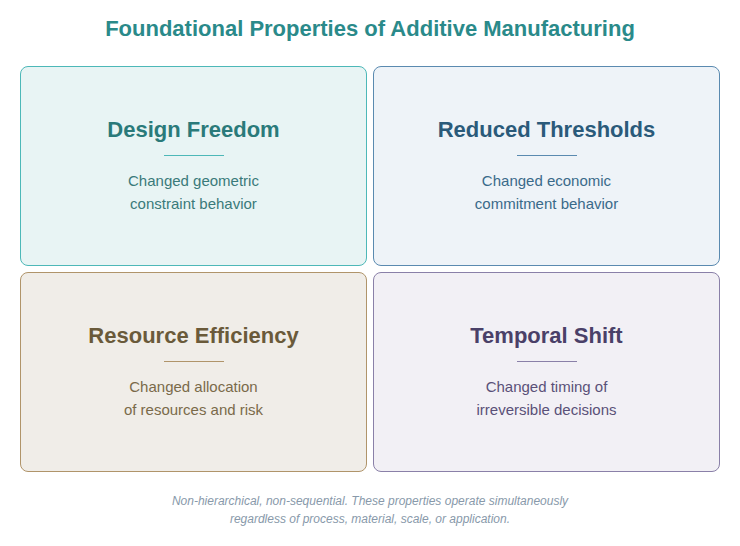
These four properties are independent and operate simultaneously. They are not steps, stages, or a sequence. The same properties are present regardless of process, material, scale, or application—what changes is the level at which their effects become visible. This series examines them where they surface first: in parts and production decisions.
The Foundational Properties describe how additive manufacturing behaves at the production level—independent of application, industry, or business model.
They are non-hierarchical and operate simultaneously. The sequence presented here reflects analytical clarity at the production level, not priority or logical dependence.
The order in which these properties appear in this series—Design Freedom, Resource Efficiency, Temporal Shift, Reduced Thresholds—reflects where each property’s effects are most immediately visible, and likely recognizable, at the production level. It is not a ranking. Readers who encounter these same properties in the system-level series or in the Strategic Impacts™ framework will find them sequenced differently there, for the same reason: what is most accessible shifts depending on the distance from which the system is examined. The properties themselves do not change. The lens does.
A component is redesigned for additive manufacturing with a narrow objective—often weight reduction, packaging efficiency, or improved performance. In the process, internal geometry is rethought, interfaces are reduced, and multiple parts are consolidated into a single component. The redesigned part achieves its original goal, but secondary effects emerge as well—fewer assembly steps, fewer failure points, improved durability, and altered production and inventory requirements. The most consequential changes were not explicitly targeted; they arose from how additive manufacturing changes geometric constraints, production thresholds, and timing at the production level.
Why Features Are an Incomplete Explanation
Much of the additive manufacturing discussion still relies on feature-based language: complex geometries, internal channels, tool-less production, speed of iteration. These features are important but they stop short of explaining impact.
Features describe what is possible.
Properties explain why certain outcomes repeatedly occur.
The distinction matters because feature-based explanations tend to remain bounded at the part or process level. They struggle to scale conceptually, even when the effects do.
When additive manufacturing is framed primarily through features, its value appears situational. Useful here. Advantageous there. Compelling in certain edge cases, but difficult to generalize.
When additive manufacturing is framed through properties, a different picture emerges.
This distinction has significant practical consequences. Feature-based explanations are inherently application-based and quickly devolve into use case examples. Property-based explanations hold across applications. The latter requires explanation once—and then it holds.
This is how classification systems work. When Mendeleev organized already known elements by atomic weight and valence, the periodic table did not introduce new chemistry. Every individual element it contained had already been isolated, studied, and described. What the table provided was structure, organization. Possibly most important, that structure turned out to be predictive. Gaps in the table indicated where undiscovered elements should exist, what their properties should be, and how they should behave. The individual observations were not new. Their organization was—and the organization explained what the observations alone could not and had not.
The Foundational Properties serve a parallel function at a much narrower scale. They do not introduce new observations about additive manufacturing—lightweighting, consolidation, on-demand production, and reduced tooling are thoroughly documented and demonstrated.
What the properties introduce is an organizing logic that explains why these outcomes reliably and predictably co-occur across unrelated industries, materials, and applications.
This explanatory work is in the organization, not the observations.
The same four properties that enable a better component also explain why additive manufacturing changes how parts are designed, when they are produced, how many are made, and where they are located. Those changes accumulate. They extend beyond the part itself and begin to influence production systems, supply chains, and planning assumptions.
This series remains deliberately and intentionally at the production level.
Why This Matters Now
As additive manufacturing continues to mature, the challenge is no longer proving that it works. The challenge is explaining what it changes—clearly enough that its implications can be understood without constant reference to use case examples.
Here, we begin where most conversations already are: with parts.
Next in the series: Design Freedom at the Part Level
Terms Used in This Article
- Foundational Property — a persistent structural characteristic that describes how additive manufacturing behaves, not a feature or benefit
- Design Freedom — changed geometric constraints
- Reduced Thresholds — changed minimum commitments required for production
- Resource Efficiency — changed patterns of resource commitment and consumption
- Temporal Shift — changed timing of when decisions and commitments must be made
See all framework terms →