
Rapid Design Iteration Without Penalty
Rapid prototyping is one of the earliest uses of 3D printing and remains one of the most widely adopted. What is often overlooked is why it is so powerful.
In conventional workflows, iteration carries cost and delay. Each design change risks scrapping tools, reworking fixtures, or restarting qualification processes. As a result, organizations learn to limit iteration and accept known compromises, including sub-par designs in standing inventories and reduced responsiveness.
Additive manufacturing reduces the penalty of iteration.
Design changes can be tested quickly, physically, digitally, and repeatedly without restarting the production clock. This allows performance issues, fit problems, or durability concerns to be addressed earlier—and more thoroughly—before designs are locked in.
The result is not simply faster development, but better-informed decisions made closer to production, and greater responsiveness to demand shifts.
Producing Here and Now
One of the most visible demonstrations of additive manufacturing’s temporal impact has been the ability to produce parts when and where and how they are needed.
This capability has been leveraged in a wide range of situations: emergency medical supplies, spare parts for disrupted supply chains, backordered components holding up production lines, and support for remote or constrained environments.
These examples are often described as exceptional or crisis-driven. In reality, they reveal a structural capability.
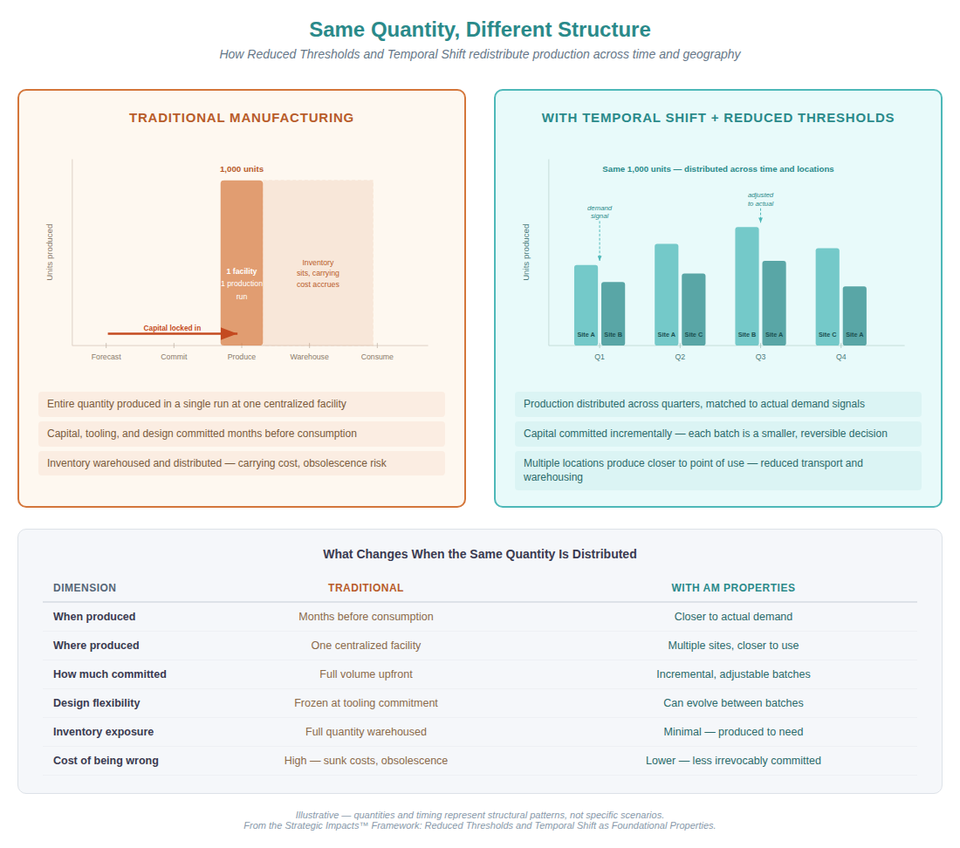
Additive manufacturing decouples production from long planning horizons. Parts do not need to be produced in advance, shipped to warehouses, and stored “just in case.” They can be produced at or near the point of need, in response to actual demand rather than forecasts, with no or limited standing inventory.
At the production level, this shifts time from a limiting constraint to a controllable variable.
What these examples share is optionality not speed.
They share the ability to act closer to the moment of actual need rather than in anticipation of a forecasted future. Optionality is the practical consequence of Temporal Shift.
Timeline Compression Without Tradeoffs
Timeline compression is often framed as a competitive advantage: faster time to market, quicker response to change. While true, this framing understates the impact.
In conventional manufacturing, compressing timelines typically increases risk or cost or both. Expedited shipping, parallel tooling efforts, and overtime labor all carry penalties. Speed is purchased at the expense of efficiency.
In conventional manufacturing, speed is measured at the production run—how quickly the full batch moves from setup to completion. This is speed in service of the production system, not speed in service of the customer. A run of ten thousand parts may be completed efficiently, but the first part and the last part arrive on the same timeline.
The customer who needs twelve parts next week waits for the same cycle as the customer who needs ten thousand. Speed, in this context, is throughput—it optimizes the producer’s economics, not the user’s timing.
Additive manufacturing redefines what speed serves. Production can respond to the customer’s need rather than the system’s batch logic.
Additive manufacturing compresses timelines structurally.
Because tooling is reduced or eliminated and production can begin directly from digital designs, shorter timelines do not inherently require additional resource commitments. Design, production, and iteration can occur in tighter loops without front-loading cost or risk.
This enables organizations to bring new products to market faster or at all—by changing the structure of the process, not by working harder.
Temporal Shift as a Foundational Property
At the part level, temporal shift explains a wide range of familiar additive manufacturing outcomes: rapid prototyping, on-demand production, local manufacturing, and faster product launches.
These are manifestations of a deeper change in how time interacts with design, production, and commitment, not isolated benefits.
By allowing decisions to be made later, closer to actual need, additive manufacturing reduces the cost of being wrong and increases the value of being responsive.
Temporal shift is not about speed for its own sake. It is about optionality—the ability to delay irreversible decisions until better information is available.
This property becomes increasingly consequential as its effects accumulate beyond individual parts, across the enterprise and supply chains. But the part level is where the shift first becomes visible.