

The difference between low volume and optional scale is not a matter of semantics. Low volume is a constraint—it caps what can be produced. Optional scale is a condition—it removes the minimum required to justify production at all. When organizations describe additive manufacturing as a “low-volume technology,” they are describing a ceiling. What actually changed was the floor.
How Conventional Manufacturing Sets Thresholds
In conventional manufacturing, production economics are dominated by fixed costs. Tooling, molds, fixtures, setup, and qualification must be absorbed before the first usable part exists. To absorb those costs, production volumes must be high and designs must remain stable over long periods of time.
As a result:
- Production decisions are front-loaded
- Minimum order quantities are imposed
- Inventory is produced in anticipation of demand
- Design changes become expensive and risky
High-volume production is often positioned as a goal in additive manufacturing discussions. In practice, it is frequently a constraint—the volume required to justify sunk costs, not the volume the business actually wants or needs.
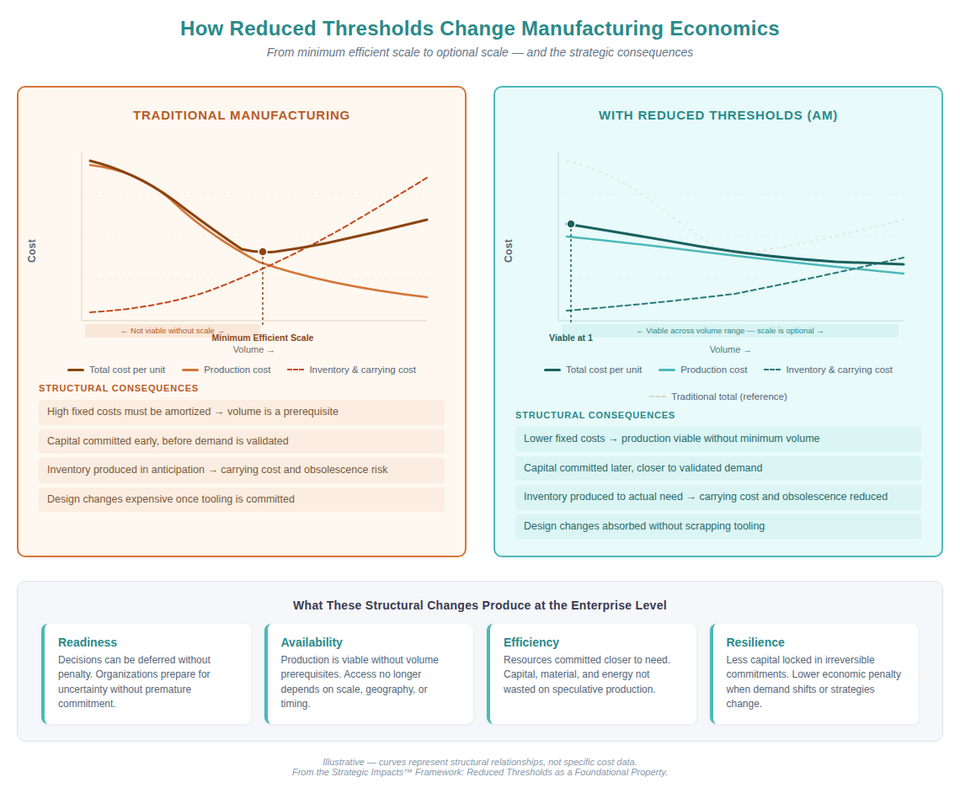
How production thresholds change under additive manufacturing
What Additive Manufacturing Changes
Additive manufacturing alters this cost-volume relationship by reducing or eliminating many of the fixed costs that drive high production thresholds. In many cases, no dedicated tooling is required to produce a component. Where tooling is needed, additive manufacturing can often be used to produce it faster, at lower cost, and closer to the point of use.
This changes the economics on both sides of the production equation:
- Fixed costs are lower and less dominant
- Variable costs may be higher per unit, but are incurred only when parts are actually produced
The most consequential economic change is a different cost structure, not a different cost curve.
Conventional manufacturing front-loads fixed costs—tooling, molds, fixtures, setup, qualification—which must be absorbed before the first part exists. These costs are fixed regardless of whether demand materializes, designs change, or requirements shift. Variable costs per unit are low, but only after the fixed investment has been justified and absorbed.
Additive manufacturing shifts much of that cost structure from fixed to variable. Tooling is reduced or eliminated. Setup is minimal. Production cost is incurred when parts are produced, not before. The result is higher variable cost per unit but dramatically lower fixed cost—and critically, cost that is incurred in response to actual need rather than in anticipation of projected demand.
This is not a tradeoff. It is a recharacterization of when, how, and under what conditions resources are committed.
Where demand is known, designs are stable, and volumes justify tooling investment, conventional fixed-cost economics remain rational. The shift matters where those preconditions do not hold—and they do not hold more often than most production systems acknowledge.
The equation is the same. The inputs have changed.
Unique, Low-Demand, and High-Demand—Revisited
Reduced thresholds apply across a wide range of demand profiles.
Unique components—such as custom medical devices, individualized consumer products, specialized tools, or one-off replacement parts—become viable because the cost of producing “just one” is no longer prohibitive.
Low-demand components—including spare parts for legacy platforms, specialty equipment, seasonal products, or limited-run designs—can be produced efficiently without carrying years of inventory or absorbing large upfront costs.
High-demand components are not excluded. What changes is that high demand no longer requires high volume production in a single location, at a single time, for a single design. Production can be distributed across time, geography, and even design variants while remaining economically viable.
The key shift is that volume becomes an outcome, not a prerequisite.
Internal and External Production Impacts
Reduced thresholds affect both internal operations and external, customer-facing production.
Internally, reduced thresholds enable rapid spare-part production without minimum order quantities, in-house tooling with short lead times, design iteration without restarting procurement cycles, and legacy equipment maintenance long after original suppliers disappear.
Externally, reduced thresholds enable new product offerings that would not justify conventional tooling, short-run or event-specific products, distributed production models that reduce logistics risk, and faster response to market or regulatory changes.
In both cases, the benefit is not simply lower cost per part, but greater optionality.
Distribution, Inventory, and Risk
One of the most significant consequences of reduced thresholds lies outside the factory.
When production no longer requires large upfront commitments, inventory can be reduced. Parts do not need to be produced months or years in advance to justify tooling costs. Distribution can shift from “push” to “pull,” reducing warehousing, transport, and the risk of obsolescence.
From a resource perspective, this avoids waste that is rarely visible in conventional analyses: unused inventory, expired materials, scrapped components, and stranded capital.
These consequences are often overlooked—not because they are small, but because they surface in a different department, a different stage of the supply chain, or a different fiscal period than the decision that caused them.
Reduced thresholds change not only how parts are made, but how risk is experienced and managed.
Reduced Thresholds as a Foundational Property
The effects described here as reduced thresholds are rarely named directly. They surface instead as observations about low volume, small batch sizes, or on-demand production — descriptions of what happened, not explanations of why. Reduced thresholds are a structural property that emerges when production is decoupled from tooling-driven economics.
At the production level, this property explains why additive manufacturing repeatedly appears in spare parts, maintenance, customization, distributed production, and supply-chain resilience discussions.
It also explains why its impact is not incremental.
When the minimum conditions for production change, entire categories of decisions become possible. What gets made, when it gets made, where it gets made, and how often it gets changed are all re-evaluated.
The point is not producing fewer parts.
The point is producing what is needed, when it is needed, where it is needed—without absorbing unnecessary commitments.