
This definition applies regardless of manufacturing method, industry, or geography. It treats sustainability not as an environmental add-on, but as an operational and strategic characteristic of well-designed manufacturing systems.
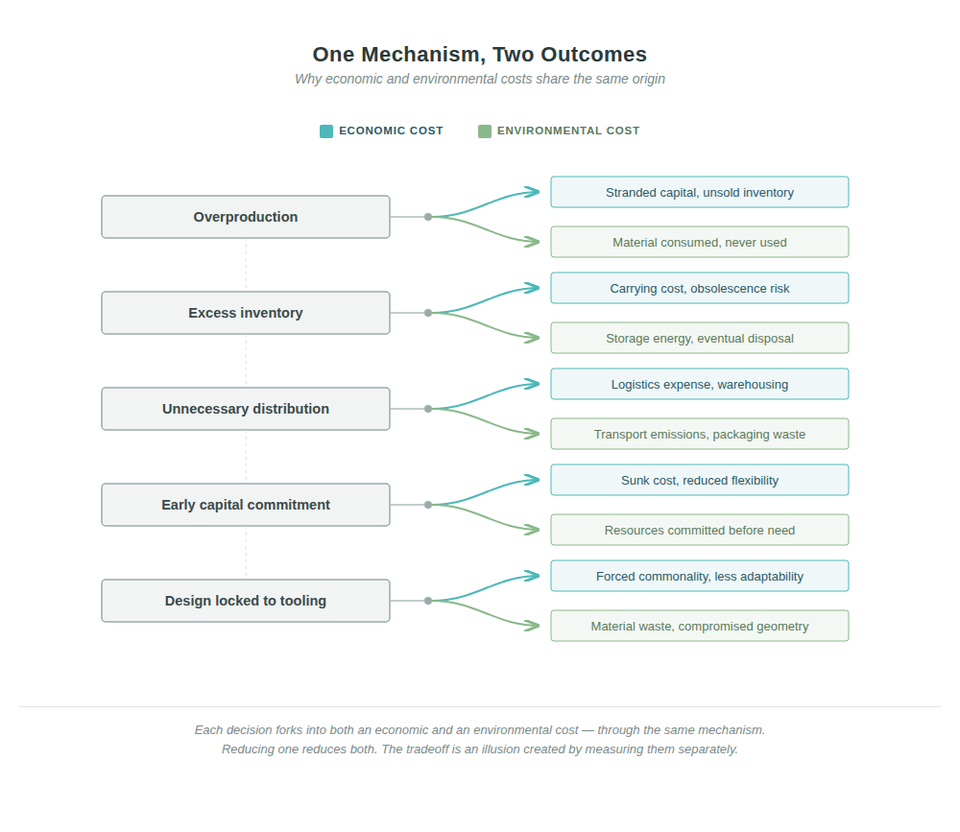
Five manufacturing decisions, each forking into an economic and an environmental cost—through the same mechanism.
Sustainable Manufacturing as Resource Management
At its essence, sustainable manufacturing is about resource efficiency.
When thinking of manufacturing, the list of considered resources is often limited to energy, materials, and, possibly, waste. From an enterprise-wide, strategic perspective, manufacturing impacts and is impacted by a much broader list of resources.
Every manufacturing organization must effectively manage resources, including:
- Inputs: materials, energy, time, labor, capital, and opportunity
- Outputs: value in products and byproducts, and waste in any of those resources
Waste includes not only physical scrap or emissions, but also:
- over-production and obsolescence
- inefficient distribution and warehousing
- idle or encumbered capital
- excess energy and labor utilization
- risk
Resource inefficiencies increase both economic cost and environmental cost. In practice, economic and environmental costs usually track together: higher energy use increases both operating expense and emissions; excess inventory ties up capital, increases waste risk, and results in missed opportunities.
The perception that economic and environmental objectives are inherently in conflict is most often the result of unrecognized or displaced costs—costs borne by other departments, partners, regions, or society rather than eliminated.
A Cognitive Shift: Waste as a Verb
Treating waste as a verb rather than a noun is not semantic preference. It is the difference between a system designed to avoid unnecessary action and a system designed to manage unavoidable consequences.
The distinction shapes every evaluation that follows in this series.
Reducing waste upstream typically delivers more immediate and durable benefits than downstream mitigation. For example:
- reducing over-production avoids warehousing, transport, and obsolescence costs
- improving production efficiency reduces both energy consumption and operating expense
- designing for flexibility reduces the risk of stranded inventory and outdated designs
Recycling can play a role, but when not performed at scale it can introduce additional logistical, economic, and environmental costs. The transport of materials to be recycled often negates any potential environmental benefit. In many cases, preventing waste in the first place delivers better results.
Scale, Flexibility, and Production Thresholds
Conventional manufacturing systems are often optimized around high volumes to reach production thresholds—the sweet spot where declining unit cost intersects rising inventory cost. While effective in stable environments, this approach can:
- delay design improvements and defect remediation
- lock organizations into sub-optimal products
- increase exposure to demand volatility and obsolescence
Working through large inventories—or scrapping them—carries significant economic and environmental cost. Sustainable manufacturing emphasizes right-sized production, adaptability, and responsiveness rather than volume for its own sake.
While high-volume production—one design, in one place, at one time—has its place in manufacturing, it is often mistaken as a goal of new practices rather than a constraint of conventional manufacturing.
Where Additive Manufacturing Fits
Additive manufacturing—a set of technologies, design approaches, and enterprise strategies based on 3D printing—can enable sustainable manufacturing outcomes, but they do not define sustainability themselves.
In appropriate contexts, additive manufacturing can improve material and energy efficiency, enable production at significantly lower thresholds, reduce or eliminate tooling requirements, support distributed production, and improve conventional manufacturing through rapid tooling and fixtures.
The most significant potential of additive manufacturing lies in its ability to decouple economic viability from high-volume production, allowing organizations to produce what is needed, when and where it is needed, with reduced capital and inventory risk.
Sustainability Without Claims
Sustainable manufacturing is defined by how manufacturing systems use resources, manage risk, and enable and sustain long-term value creation.
Words matter. Without clear definitions, sustainability discussions risk becoming either a marketing label or a narrow compliance exercise. With clear definitions, sustainable manufacturing becomes a practical discipline grounded in real manufacturing decisions. Establishing common language and definitions allows for greater progress, increased understanding, less confusion, and better outcomes.
Why This Definition Matters
Manufacturers today face increasing disruption—from geopolitical instability and supply-chain fragility to climate impacts and shifting markets. Availability and resiliency have never been more important. Sustainable manufacturing provides a framework for building systems that are:
- more efficient
- more resilient
- more adaptable
- better aligned with long-term economic and environmental performance
This reference definition is intended to serve as a stable foundation for further discussions of technologies, strategies, and framework—including additive manufacturing—without conflating tools with outcomes.
This definition informs the analysis of both the Foundational Properties of Additive Manufacturing and the Strategic Impacts™ framework. Readers encountering those frameworks are encouraged to return to this definition when evaluating claims about resource efficiency, structural sustainability, or waste reduction.