
Why Temporal Shift Is Not Speed
Speed asks how fast something happens.
Temporal shift asks when something must happen.
A slow additive process can still exhibit temporal flexibility. A fast conventional process often does not. The difference lies not in cycle time, but in when design freezes occur, when capital is committed, and when alternatives collapse.
This distinction explains why debates about print speed so often miss the point. Once manufacturing no longer requires mass quantity, the role of speed changes.
Responsiveness, availability, and timing become more important than raw throughput.
Distributed Time, Not Compressed Time
In conventional manufacturing, time pressure is often addressed by compression: producing faster, scheduling tighter, scaling larger.
Additive manufacturing enables a different response: distribution.
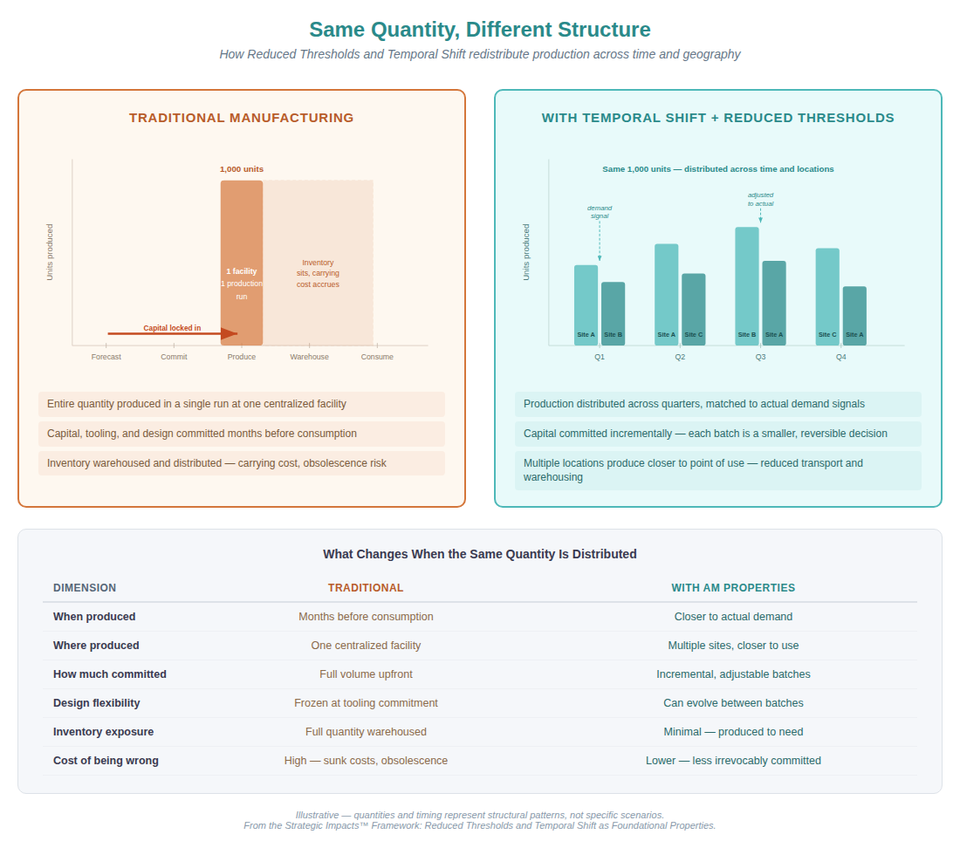
Production can be spread across time, geography, designs, and demand signals rather than concentrated into a single event. Manufacturing no longer needs to happen all at once, in one place, of a single design, or far in advance of use.
This changes how organizations think about availability, opportunity, spares and service parts, contingency production, volatile demand, and distribution strategy.
The system becomes less brittle because it relies less on early certainty.
Temporal Shift and the Other Foundational Properties
Temporal shift does not stand alone. It overlaps intentionally and cannot be separated from the other Foundational Properties:
- Design Freedom allows design intent to remain flexible longer
- Reduced Thresholds remove the need to justify action through scale
- Resource Efficiency reduces the cost of acting later rather than earlier
- Temporal Shift governs when action must occur
Together, these properties describe a manufacturing system in which time is no longer a rigid constraint, but a variable that can be managed structurally rather than reactively.
Temporal Shift Manifest As Two Distinct Strategic Impacts
Temporal Shift is unique among the Foundational Properties in that it produces two Strategic Impacts with equal primacy: Readiness and Resilience.
Both emerge from the same temporal mechanism—the ability to defer irreversible decisions—but they manifest as different organizational conditions.
Readiness is operational and strategic preparedness—the capacity to act when conditions clarify rather than being forced to act early—deferred decisions, capability without premature commitment, and position without closing off options.
Resilience is economic capacity to execute—the financial flexibility to fund adaptation when needed. Deferral preserves optionality—capital not yet committed remains available to redirect.
The critical distinction: An organization can have one without the other
An organization might be operationally prepared to respond to demand shifts but lack the financial resources to execute because capital is tied up in existing commitments. That organization has Readiness without Resilience. Preparedness exists without the means to act on it.
Conversely, an organization might have significant financial flexibility but lack the operational systems or capabilities to deploy it effectively. That organization has Resilience without Readiness. Capital is available but cannot be converted to action.
Both are necessary. Neither is sufficient alone.
Temporal Shift’s contribution is that it produces both readiness and resilience simultaneously. The same deferral that creates operational preparedness (Readiness) also creates economic adaptability (Resilience). Organizations that integrate additive manufacturing effectively gain both the ability to wait for clarity and the financial capacity to act on it when it arrives.
This dual emergence explains why Temporal Shift is one of the most strategically consequential Foundational Properties.
Why Temporal Shift Has Been Under-Articulated
Historically, time has been absorbed into other narratives:
- faster prototyping
- shorter lead times
- agile development
- speed to market
These are outcomes, not explanations.
By focusing on speed, the industry has struggled to articulate why additive manufacturing consistently appears in environments characterized by uncertainty, variability, and risk. Temporal shift explains that pattern without relying on examples or exceptions.
What Temporal Shift Does—and Does Not—Explain
Temporal shift does not guarantee responsiveness. It does not eliminate tradeoffs. It does not make planning or forecasting unnecessary.
What it does is explain why additive manufacturing tolerates uncertainty differently than conventional manufacturing systems. It clarifies why decisions can be deferred, why production can be localized or distributed, and why availability often matters more than throughput.
It is not a strategy. It is a structural condition.
Why Naming Temporal Shift Matters
Without naming Temporal Shift explicitly, additive manufacturing is often mischaracterized as slow, inefficient, or immature. Lead-time comparisons are misapplied. Speed is overemphasized. Structural flexibility is undervalued.
Naming this property provides language for what practitioners already experience but rarely articulate: additive manufacturing changes not just how parts are made, but when making them makes sense.
The four Foundational Properties—Design Freedom, Reduced Thresholds, Resource Efficiency, and Temporal Shift—describe what additive manufacturing changes structurally. They operate at the part level and at the system level. They are present whether or not they are recognized, measured, or accounted for.
What they do not describe is what happens when those structural changes accumulate across an organization—when they begin to influence not just how parts are made, but how organizations prepare, supply, and operate. That is the subject of the Strategic Impacts™ series.
The transition from Foundational Properties to Strategic Impacts is not a change in subject. It is a change in distance.