
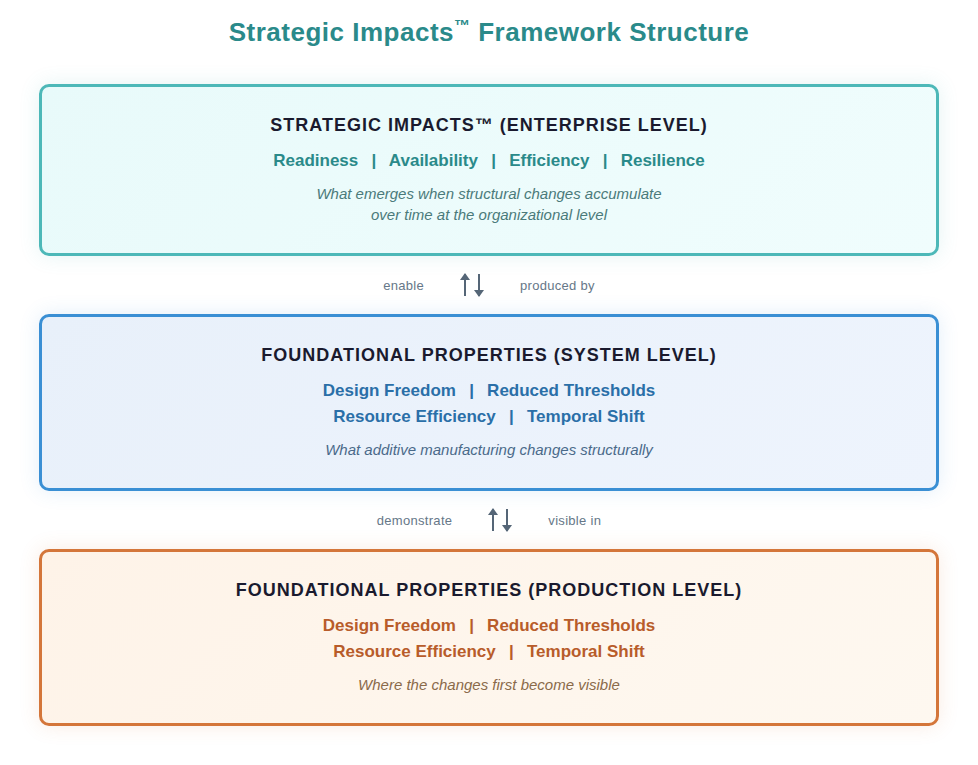
The Foundational Properties of additive manufacturing—Design Freedom, Reduced Thresholds, Resource Efficiency, and Temporal Shift—explain why additive manufacturing behaves differently from conventional manufacturing at the production and system levels. They describe structural changes in how geometric constraints, economic thresholds, resource commitments, and timing decisions operate.
The Strategic Impacts™—Readiness, Availability, Efficiency, and Resilience—describe what emerges at the enterprise level when those structural changes operate consistently over time.
The Strategic Impacts are not goals to pursue or benefits to optimize. They are organizational conditions that emerge when the Foundational Properties influence decision-making across the enterprise rather than within isolated applications.
This article explains how the four impacts emerge from the four properties—and why that relationship is neither linear nor one-to-one.
The Four Properties, Briefly Revisited
Before mapping properties to impacts, it is worth revisiting each property:
Design Freedom describes the removal of geometric penalties that conventional manufacturing imposes—changed constraints, where geometry itself becomes a weaker determinant of what can be produced economically.
Reduced Thresholds describes the lowering of minimum volumes required before production becomes economically viable—changing both operational viability (what volumes make sense) and economic structure (how much capital must be committed before production begins).
Resource Efficiency describes the structural change in how resources—material, energy, capital, time, opportunity, and risk—are allocated and committed. Overproduction, excess inventory, and unnecessary distribution are avoided structurally, not optimized after the fact.
Temporal Shift describes the change in when irreversible decisions must be made—when commitment becomes irreversible and what flexibility is preserved by delaying those commitments.
These four properties operate simultaneously—they overlap and cannot be separated. They do not appear in sequence, nor do they depend on one another for validity. They are structural characteristics of how additive manufacturing behaves, observable across industries, applications, and maturity levels.
The Four Strategic Impacts
The Strategic Impacts are described here as organizational conditions—not problems to solve or objectives to achieve, but states that exist when the Foundational Properties operate consistently across an enterprise—the ripple effects.
A condition, as used here, is something that is present in the organization, shaping decisions and capacity, whether or not it has been named, intended, or measured. Readiness, Availability, Efficiency, and Resilience are not pursued. They exist and they are recognized.
At the enterprise level, when the Foundational Properties operate consistently across an organization—not in isolated pilots or exceptional applications, but as influence on core decision-making—they manifest as four Strategic Impacts.
Readiness is the condition of being prepared to respond to change without being prematurely committed. It is not speed of execution. It is the capacity to act when conditions clarify rather than being forced to act before they do. Readiness emerges when organizations can defer decisions without losing capability and maintain options without the penalty of early commitment.
Availability is the condition of having access to what is needed — parts, capabilities, design solutions, resources — on terms defined by actual requirements rather than by conventional manufacturing’s assumptions about volume, geometry, or centralization. Availability emerges when organizations can produce what they need, where they need it, in quantities that match actual need rather than economic minimums.
Efficiency is the condition where resources—capital, material, energy, time —are committed to what is needed rather than consumed by what is not. Economic efficiency and environmental efficiency are not competing objectives to be balanced—they are unified consequences of the same structural change. Efficiency emerges when the structure of production directs resources toward actual need, and both economic and environmental waste decline as a single consequence.
Resilience is the condition of being able to adapt when conditions change—whether that change is disruption to absorb or opportunity to pursue—without disproportionate financial penalty. Resilience is economic adaptability and capital flexibility. It emerges when organizations can redirect resources rather than remain locked into irreversible commitments, when capital remains available rather than stranded, and when shifting direction is a financial option rather than a financial crisis.
These are not benefits additive manufacturing delivers. They are conditions that exist when additive manufacturing’s structural properties operate at organizational scale.
Why the Naming Matters
Without the Strategic Impacts, the Foundational Properties can appear narrow or technical—part-level observations rather than influences that extend into enterprise decision-making. Without the Foundational Properties, the Strategic Impacts can sound abstract or aspirational—goals to pursue rather than conditions to explain.
The two layers need each other.
Together, they provide what has been missing: a way to explain additive manufacturing that is neither promotional nor technical, neither abstract nor example-dependent. The Properties explain why additive manufacturing behaves differently. The Impacts name what those differences express at organizational scale. Neither is complete alone.
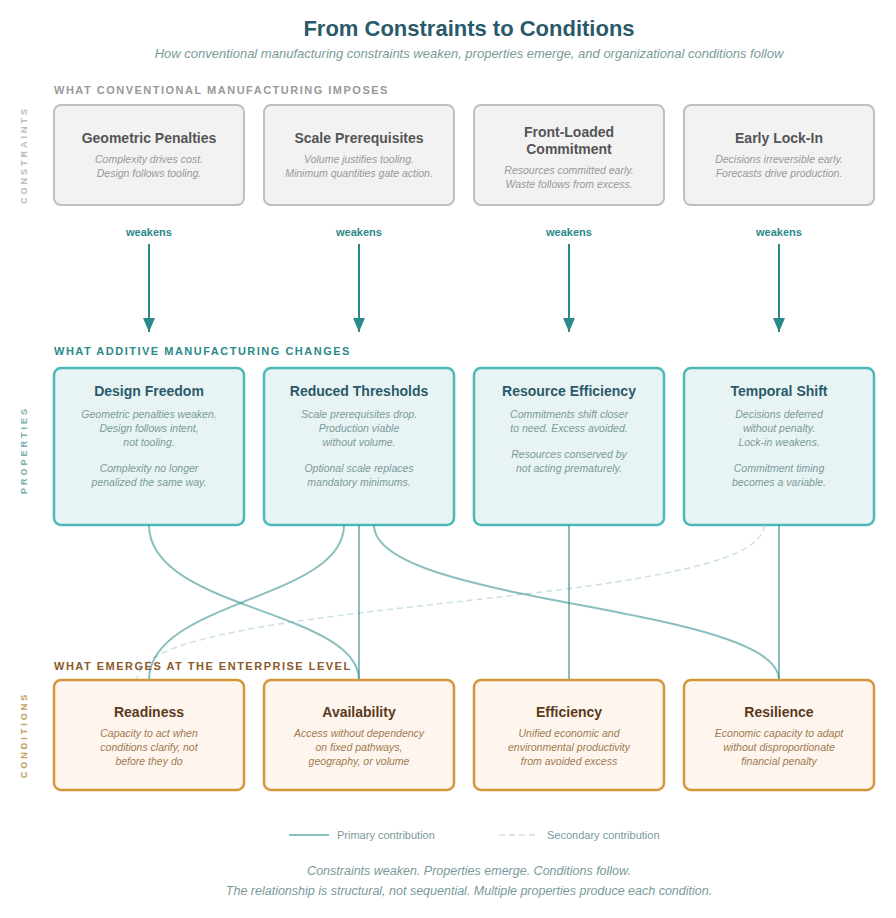
From conventional constraints to Foundational Properties to Strategic Impacts
How Properties Become Impacts
The relationship between Foundational Properties and Strategic Impacts is not one-to-one. Each Strategic Impact draws on multiple properties. Each property contributes to multiple impacts. This overlap reflects how additive manufacturing actually behaves in integrated systems.
Each link that follows is a mechanism, not an association. A
property produces an impact through a specific causal path—what changes, what
that change makes possible, and what organizational condition results from it.
The mapping is many-to-many rather than one-to-one not because the
relationships are loose, but because a single structural change propagates
along more than one path. Forcing each property onto a single impact would
describe the framework less accurately, not more. The primary link names the
path a property travels most directly; the secondary links name the further
paths the same change opens.
Design Freedom manifests primarily as Availability by removing geometric penalties and enabling access to previously impossible or economically impractical design solutions. Secondarily, geometry that follows function uses less material and energy per part (Efficiency), and design changes that no longer wait on tooling speed iteration (Readiness).
Reduced Thresholds manifests primarily as both Availability and Resilience—equally and simultaneously. Lower minimum volumes enable supply access without scale prerequisites (Availability) while simultaneously reducing capital commitments required for production to be viable (Resilience). This dual effect is not coincidental—it reflects how threshold reduction changes both operational access and economic structure. Secondarily, action that no longer waits for volume lets the organization stay prepared without committing early (Readiness), and producing closer to need rather than in batches reduces overproduction (Efficiency)
Resource Efficiency manifests primarily as Efficiency through unified economic-environmental outcomes: when resources are committed closer to need, both capital and material waste decrease simultaneously—not as separate benefits but as a single structural consequence. Secondarily, capital not committed to excess stays available to redeploy (Resilience), and waste removed from the supply chain loosens the dependencies that constrain access (Availability).
Temporal Shift manifests primarily as both Readiness and Resilience—equally and simultaneously. Deferring irreversible decisions creates operational preparedness (Readiness) and economic adaptability (Resilience) through the same temporal mechanism. Organizations gain both the ability to wait for clarity (Readiness) and the financial flexibility to act on that clarity (Resilience). Secondarily, deferring commitment brings resources closer to need and reduces excess (Efficiency), and timing flexibility lets production be placed when access requires it (Availability).
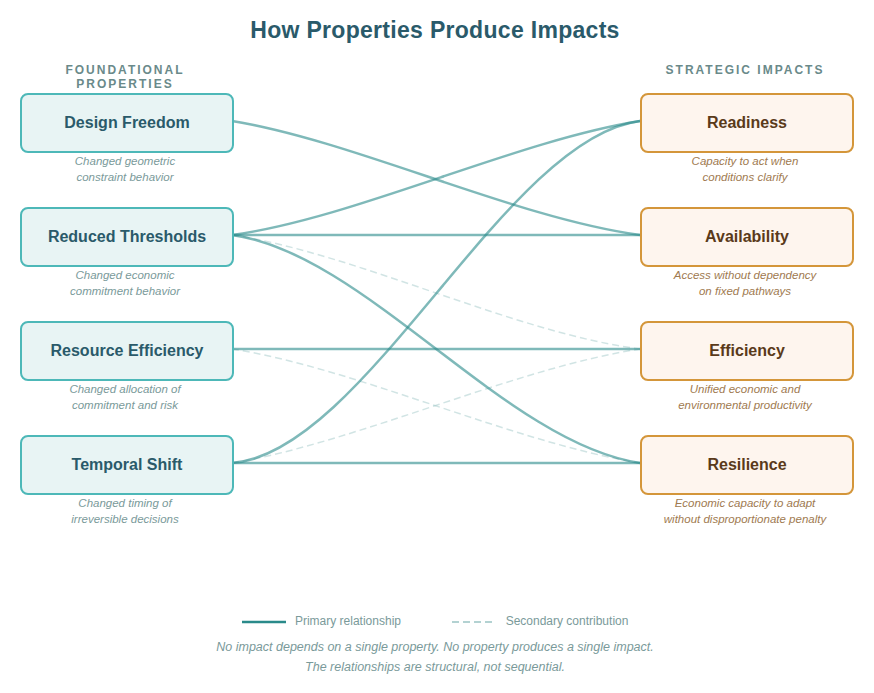
How the four Foundational Properties map to the four Strategic Impacts
Why Four Impacts
The four Strategic Impacts—Readiness, Availability, Efficiency, and Resilience—consistently emerge when the Foundational Properties operate at enterprise scale. These are the organizational conditions that exist across industries, applications, and maturity levels.
Could there be fewer? Three impacts would be incomplete. Economic adaptability (Resilience) and operational preparedness (Readiness) are distinct conditions that both emerge from temporal deferral—organizations need both the ability to wait for clarity and the financial capacity to act on it.
Could there be more? Innovation Capacity has been considered—the organizational ability to iterate, experiment, and translate design intent systematically. But Innovation Capacity is better understood as what organizations do with the four Strategic Impacts, not an impact itself. When Readiness, Availability, Efficiency, and Resilience are directed toward product development, innovation becomes systematic rather than exceptional. Innovation Capacity is an application outcome, not a fifth Strategic Impact.
The test is not rhetorical elegance but structural accuracy. Do these four conditions consistently emerge when the Foundational Properties operate at enterprise scale? They do.
From Properties to Impacts: What Changes
The progression from Foundational Properties to Strategic Impacts is not a maturity model. It is not a sequence of stages or a roadmap of implementation steps.
It is a change in distance.
At the production level, the properties are directly observable. Design Freedom appears as complex geometries. Reduced Thresholds appears as viable low-volume production. Resource Efficiency appears as material savings per part. Temporal Shift appears as shortened lead times.
At the system level, the same properties appear less tangibly but more consequentially. Design Freedom appears as changed design processes. Reduced Thresholds appears as different economic calculations. Resource Efficiency appears as altered commitment patterns. Temporal Shift appears as deferred decision points.
At the enterprise level, the properties disappear into organizational behavior. What becomes visible instead are their organizational expressions: Readiness, Availability, Efficiency, Resilience. Not as achievements to celebrate, but as operating characteristics—how the organization prepares, supplies, allocates resources, and adapts.
The properties do not vanish. They continue to operate. But at the enterprise level, what matters is not the properties themselves but how they express collectively when sustained over time.
This is the bridge.
From observable structural changes at the production level, to consequential influences at the system level, to emergent organizational conditions at the enterprise level. The same four properties. The same underlying behavior. Different manifestations depending on distance and scale.
Organizations that understand the properties can explain what changed.
Organizations that recognize the impacts can explain what emerged.
Organizations that understand both can explain why it matters.
Reader’s Note:
Readers seeking the full structural explanation behind any property can find it in the Foundational Properties series—beginning with The Foundational Properties at a System Level for organizational perspective, or The Foundational Properties at a Production Level for technical depth.