
By the time additive manufacturing reaches senior leadership agendas, it is rarely unfamiliar.
Most executives have seen the demonstrations. Many have approved pilots. Some have funded centers of excellence or capital investments tied to specific applications. In a growing number of organizations, additive manufacturing is technically competent, operationally proven, and supported by experienced teams.
And yet, it has no strategic role.
What Has Been Missing
This gap does not stem from a lack of data, evidence, or technical rigor. It arises from the absence of a shared structure for interpreting what additive manufacturing changes once it moves beyond isolated use cases.
Without such a structure, the technology is discussed in fragments—operational in one context, aspirational in another—without a stable way to assess its organizational effect.
Over time, a consistent pattern becomes visible. Additive manufacturing is understood in detail, but not in total. Conversations expand into examples rather than resolve into fundamentals. Even among experienced practitioners, explanations tend to accumulate without converging.
This fragmentation makes it difficult to articulate why additive manufacturing matters strategically, even when its technical value is well established.
Strategic Impacts, Not Priorities
One reason additive manufacturing’s strategic impact remains difficult to articulate is that the sector itself has never converged on a concise description of its core advantages. Discussions tend to enumerate applications, features, or success stories rather than distilling first-order characteristics.
When reduced to fundamentals, however, additive manufacturing’s technical and economic advantages consistently resolve into four properties: design freedom, resource efficiency, reduced thresholds, and temporal shift. Nearly every commonly cited benefit—from customization and lightweighting to digital inventory and localized production—can be traced back to one or more of these.
Design freedom — components no longer constrained by what tooling can produce.
Reduced thresholds — production no longer requires volume to justify the investment.
Resource efficiency — resources committed closer to actual need rather than speculative forecast.
Temporal shift — decisions that no longer must be locked in months before demand is known.
The Strategic Impacts™ describe what happens when those advantages are allowed to influence decision-making beyond engineering. Design freedom, reduced thresholds, resource efficiency, and temporal shift translate into familiar strategic benefits such as performance flexibility, responsiveness, resource productivity, and resilience.
When those benefits are no longer episodic but integrated, they appear as four recurring organizational conditions: readiness, availability, efficiency and resilience. A condition, as used here, is something that is present—shaping decisions and capacity—whether or not it has been named or measured.
The lineage of these impacts is direct.
Readiness emerges from Temporal Shift and Reduced Thresholds.
Availability emerges from Reduced Thresholds and Design Freedom.
Efficiency emerges from Resource Efficiency operating structurally.
Resilience emerges from Reduced Thresholds and Temporal Shift.
None of these impacts is separable from the Foundational Properties from which they emerge.
They are not objectives to be pursued, or outcomes to be claimed. They are strategic impacts—observable shifts in organizational capability that occur when additive manufacturing is positioned as infrastructure rather than exception.
Readiness reflects an organization’s ability to respond without reconfiguration.
When additive manufacturing contributes to readiness, it reduces the need for advance commitment, tooling lock-in, or long lead-time decisions. It changes how organizations prepare for uncertainty, not by predicting disruption, but by reducing the cost of being wrong.
Availability reflects an organization’s ability to provide without dependency.
This extends beyond conventional notions of supply chain resilience. Availability includes the ability to decouple access from geography, volume, and sequencing, and to maintain access when conventional pathways are constrained or unavailable.
Efficiency reflects unified economic and environmental resource productivity.
It is not defined by claims or offsets. Efficiency emerges when material use, logistics intensity, inventory exposure, and energy consumption are reduced as a consequence of how production is structured—not as after-the-fact optimization. Material saved is also capital saved. Energy reduced is also cost reduced. Economic and environmental efficiency are unified consequences of avoided excess.
Resilience reflects economic capacity to adapt without disproportionate financial penalty.
Whether the change is disruption to absorb or opportunity to pursue, resilience determines what adaptation costs. Resilience is distinct from Readiness: Readiness is operational preparedness, Resilience is economic capacity. Organizations can be ready but financially constrained, or flexible but operationally unprepared. Both are necessary; neither is sufficient alone.
These impacts are not abstractions. They are observable in decisions that change, commitments that shift, costs that do not appear, and opportunities that become actionable.
An organization that maintains production readiness without carrying months of inventory has not achieved a feeling—it has changed its cost structure.
A supply chain that can source a qualified component without a six-month tooling cycle has not gained a concept—it has gained access it did not previously have.
The Strategic Impacts are visible not in dashboards designed for conventional manufacturing, but in the gap between what an organization has required and what it requires now.
Engineers who ask “how do we measure this?” are asking the right question. The answer is not that these impacts cannot be measured. It is that measuring them requires observing what the organization no longer needs to do—and what it can now do that it couldn’t before. Most manufacturing-based measurement systems are not designed to capture absence, although finance and operations systems do.
These impacts are frequently discussed independently. Readiness appears in conversations about agility and responsiveness. Availability surfaces during disruption or geopolitical uncertainty. Sustainability is often addressed through reporting frameworks and targets. What is missing is a unifying frame that explains how these impacts relate—and why additive manufacturing influences all four simultaneously.
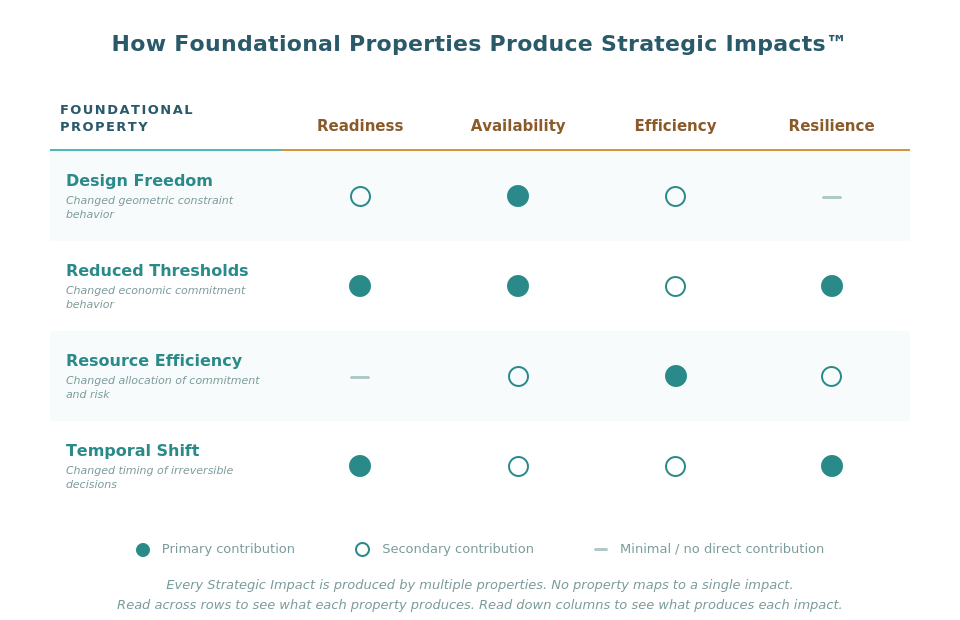
The many-to-many relationship between Foundational Properties and Strategic Impacts
Why the Impacts Are Non-Hierarchical
The Strategic Impacts are intentionally non-hierarchical. They do not mature in sequence, and they do not compete for priority. Organizations that attempt to “start” with one and “progress” to the others misinterpret what they are observing. The impacts reinforce one another. When one is isolated, the others tend to remain unrealized.
This is where many additive manufacturing strategies lose coherence.
Organizations may achieve technical success without strategic influence. They may demonstrate sustainability metrics without altering underlying structures. They may invest in readiness capabilities that never translate into availability at scale. These outcomes are often attributed to execution challenges, but more commonly they reflect a lack of interpretive structure.
The non-hierarchical structure of the Strategic Impacts is not a design preference. It reflects how the Foundational Properties behave.
Design Freedom, Reduced Thresholds, Resource Efficiency, and Temporal Shift do not operate in sequence at the part level. They operate simultaneously. Their enterprise-level manifestations—Readiness, Availability, Efficiency, and Resilience—inherit that simultaneity. Imposing hierarchy on the impacts misrepresents the properties from which they emerge.
Once a strategic framework is introduced, a familiar impulse follows. Leaders ask which element comes first. Which matters most. Which should be addressed now, and which can wait. This instinct is understandable. Hierarchy simplifies decision-making. It creates order, sequence, and apparent clarity.
In the context of additive manufacturing, this instinct is also misleading.
One impact is elevated as foundational while others are deferred. Organizations may focus on readiness while positioning availability as a downstream concern, or pursue efficiency initiatives without addressing readiness or availability structures—delivering uneven or disappointing results.
Not because the technology is insufficient, but because its effects are being selectively interpreted.
Hierarchy also encourages substitution. If one impact is positioned as primary, organizations attempt to compensate for gaps in the others through additional investment, policy, or process.
Readiness without availability becomes brittle.
Availability without efficiency becomes costly.
Efficiency without readiness becomes constrained.
Resilience without availability becomes theoretical.
Each impact depends on the presence of the others to remain durable.
This does not mean that organizations see the impacts simultaneously or equally. Visibility varies. One impact may be more apparent given current pressures or priorities. But visibility should not be mistaken for primacy.
What is most noticeable at a given moment is not necessarily what is most influential over time.
Non-hierarchy also changes how additive manufacturing maturity is assessed. If maturity is measured by progression—moving from readiness to availability to efficiency to resilience—organizations will appear stalled or regressive when impacts do not align neatly. In reality, misalignment often reflects partial integration rather than lack of advancement.
A non-hierarchical frame allows leaders to ask different questions. Instead of asking which impact has been achieved, they can ask which organizational assumptions remain unchallenged.
Instead of ranking priorities, they can examine where structural dependencies still govern decisions. Instead of sequencing initiatives, they can ask whether the organization’s decisions are telling the same story.
What Is New—and What is Not
This framework provides a structure that explains why additive manufacturing’s impact is often felt before it is understood—and why clarity, rather than advocacy, is now the more urgent requirement.
The Strategic Impacts are not a new argument for additive manufacturing’s value. The argument for value has been made, many times. What is new is the structure—the organization of consistent organizational patterns into a framework that explains rather than advocates. The goal is not to close the debate but to give it better language.