
Resilience Is Not Readiness
Resilience and Readiness emerge from the same Foundational Properties. They are not the same thing.
Both relate to responding to change. Both emerge primarily from the same Foundational Properties (Temporal Shift and Reduced Thresholds). Both appear when organizations integrate additive manufacturing at scale. The overlap creates continued misunderstanding.
Readiness is operational and strategic preparedness. It is the capacity to act when conditions clarify rather than being forced to act before they do. Organizations with Readiness can defer decisions, maintain capability without premature commitment, and position for multiple futures without closing off options.
Resilience is economic capacity to execute that action. It is the financial flexibility to fund adaptation when needed. Organizations with Resilience have capital available to redirect because less has been locked into irreversible commitments.
The distinction becomes visible when organizations face change.
An organization might be operationally prepared to produce alternative designs, respond to demand shifts, or pivot supply strategies—but lack the financial resources to execute because capital is tied up in previous commitments—tooling, inventory, and supplier contracts. That organization has Readiness without Resilience. Preparedness exists without the means to act on it.
Conversely, an organization might have significant financial flexibility and low capital commitments—but lack the operational systems, processes, or capabilities to execute rapid adaptation. That organization has Resilience without Readiness. Capital is available but cannot be deployed effectively.
Both Readiness and Resilience are necessary. Neither is sufficient alone.
Organizations that pursue Readiness while ignoring Resilience build operational preparedness they cannot afford to use. Organizations that pursue Resilience while ignoring Readiness accumulate financial flexibility they cannot deploy effectively.
Additive manufacturing’s contribution is that the same structural changes deliver both simultaneously. Temporal Shift creates both the ability to defer decisions (Readiness) and the economic benefit of deferring capital deployment (Resilience). Reduced Thresholds create both the capability to act at appropriate scale (Readiness) and the reduced capital commitment that preserves financial flexibility (Resilience).
The distinction matters because it changes where organizations invest, what they measure, and how they assess whether integration is working.
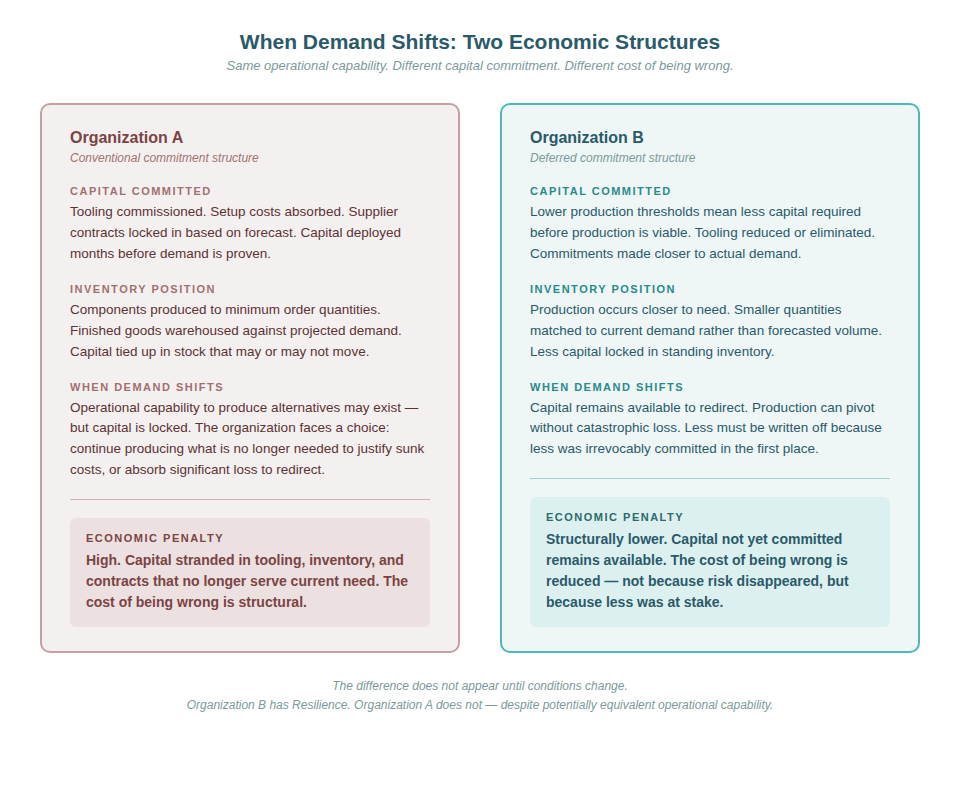
Two organizations, same technology, different interpretation
Why Resilience Resists Measurement
Resilience is difficult to recognize because it manifests as what does NOT happen.
Organizations measure what they produce, what they spend, what they save. Resilience delivers none of these directly. It appears as capital not stranded, losses not absorbed, opportunities not foregone, write-downs not required.
Conventional metrics miss this. Balance sheets do not capture preserved optionality. Income statements do not reflect reduced exposure to forecast error. Performance dashboards do not measure the financial penalty avoided when strategic direction changes.
As a result, Resilience is chronically undervalued—even in organizations where it operates effectively.
Consider two organizations facing the same demand shift.
Organization A has committed significant capital to tooling, inventory, and supplier contracts based on forecast. When demand shifts, capital is locked. The choice is binary: continue producing what is no longer optimal, or absorb significant financial loss to redirect. Organization B has deferred capital commitments through lower production thresholds and temporal flexibility. When demand shifts, capital remains available to redirect. The organization pivots without catastrophic loss.
Organization B has Resilience. Organization A does not—despite equivalent operational capability.
The difference does not appear on quarterly reports until the shift occurs. Resilience is latent—the capability matters most precisely when it has not yet been needed.
Organizations that measure only what has happened, looking backward, miss what has been preserved.
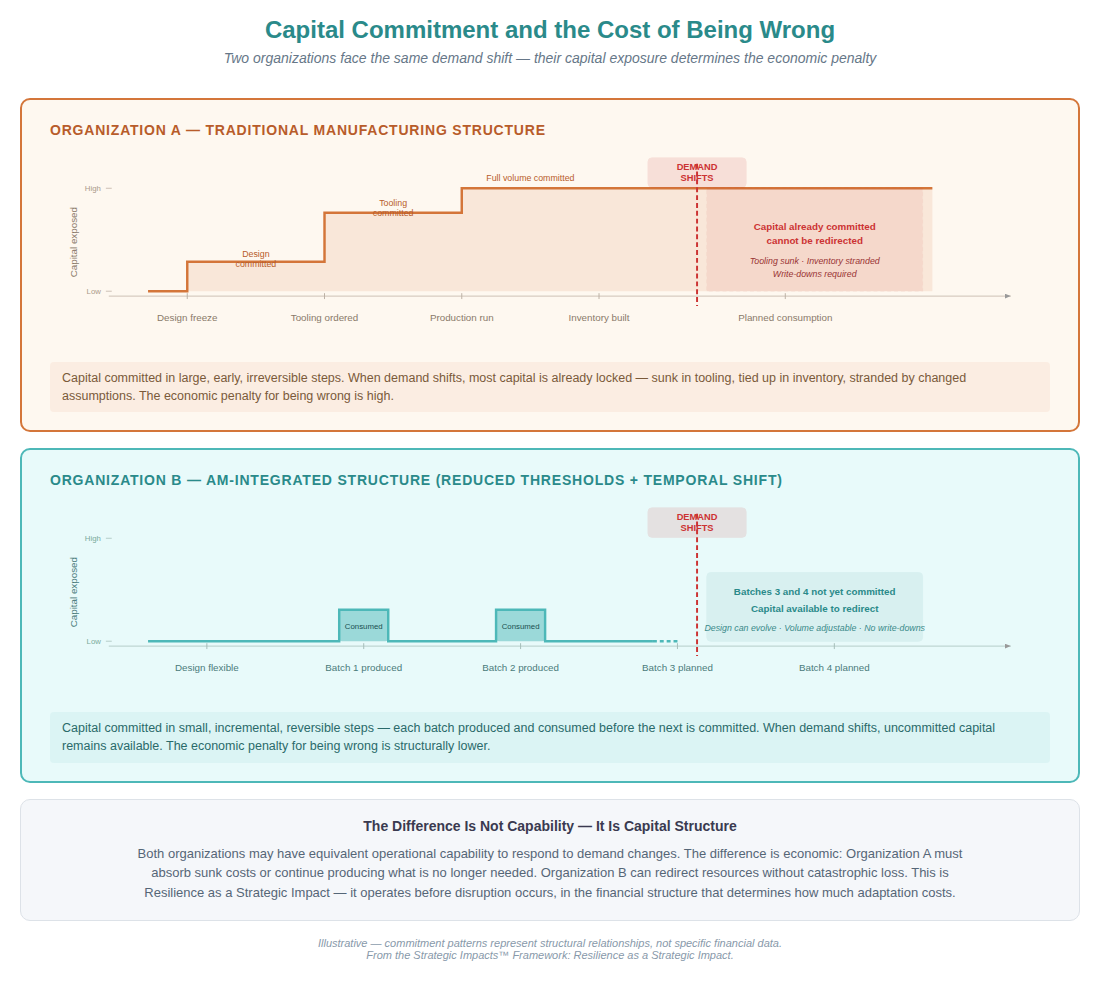
When capital commitments become irreversible
Resilience as Structural Outcome
Resilience does not emerge from strategic intent or risk management practice. It emerges when manufacturing structure changes the economics of capital commitment.
Reduced Thresholds lower the capital required before production becomes viable. Conventional manufacturing requires significant upfront investment in tooling, setup, and fixed costs. Once capital is committed, it becomes sunk cost—creating economic pressure to continue using it even when assumptions change. When production becomes viable at lower volumes without proportional tooling investment, less capital must be locked in. The financial penalty for being wrong is structurally lower.
Temporal Shift allows capital deployment to be deferred until conditions clarify. Conventional manufacturing forces early commitment—design, tooling, volume, and sourcing decisions locked in months or years before consumption. When decisions can be deferred without penalty, capital commitments shift toward actual need rather than speculative projection. This preserves optionality: capital not yet committed remains available to redirect when priorities change.
The ability to decide later has measurable value, independent of what you eventually decide. A dollar not yet committed to tooling is worth more than a dollar already spent on tooling, even if you end up buying the same tooling—because until you commit, that dollar could go somewhere else. That flexibility is itself an asset. Finance calls it optionality. This framework treats it as a structural consequence of how additive manufacturing changes when commitments must be made.
Resource Efficiency contributes secondarily by freeing working capital that would otherwise be tied up in unnecessary production, inventory, or distribution. Capital not wasted on excess is capital that remains accessible.
Together, these property changes alter the financial structure of adaptation. Organizations do not become immune to change—they become less financially penalized when change occurs, and it will.
This is why Resilience appears consistently in organizations with mature additive manufacturing integration, even when those organizations did not pursue it as an objective. It emerges as a consequence of how the Foundational Properties change capital commitment patterns.
Strategic Misreadings
The most common strategic error is positioning Resilience as an operational capability rather than an economic condition.
Organizations invest in redundant supply chains, maintain excess inventory, build business continuity plans—and believe they have achieved resilience. They have achieved robustness, which has value. But robustness requires capital deployment to maintain redundancy. Resilience preserves capital by reducing the magnitude of irreversible commitments.
The second error is assuming Resilience and Readiness are the same capability. Organizations build operational preparedness—design flexibility, process capability, technical readiness—and assume financial flexibility will follow. It does not. Operational capability without economic capacity creates preparedness that cannot be executed.
The third error is measuring Resilience through recovery speed after disruption. Fast recovery is valuable. But Resilience operates before disruption occurs—in the economic structure that determines how much adaptation costs when it becomes necessary.
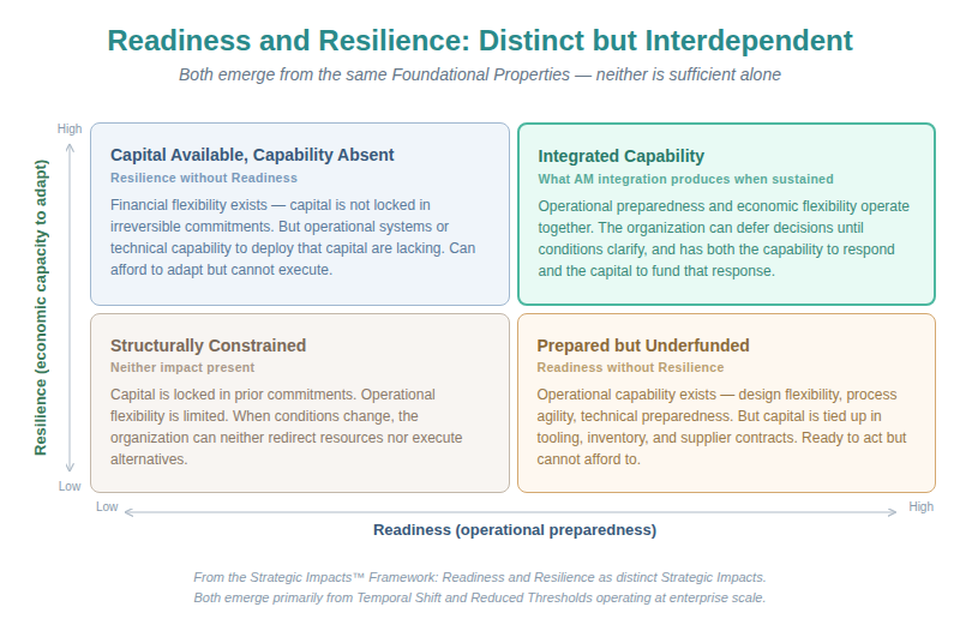
Readiness vs. Resilience: operational preparedness and economic capacity
Organizations that recognize Resilience as a distinct Strategic Impact measure differently. They track working capital intensity, capital commitment timelines, financial exposure to forecast error, and cost of strategic pivots. They assess whether economic structure has changed, not whether recovery from specific disruptions has accelerated.