
Strategic Impacts™ Framework > Foundational Properties: Production Lens > Article 2 of 5
New to this work? Begin with the The Strategic Impacts Framework: An Introduction | Reader’s Guide
Series Progress ●●●○○
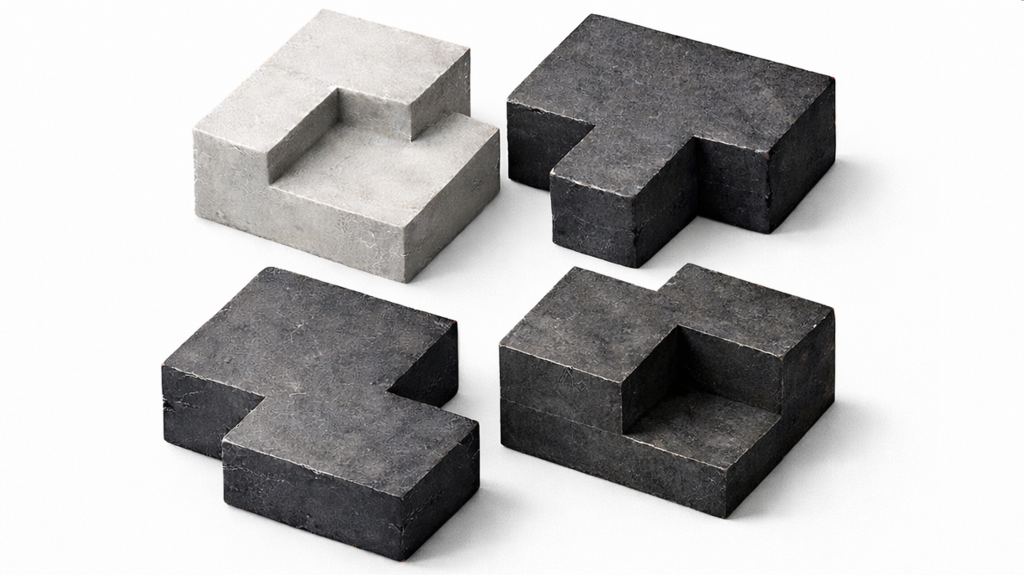
Design Freedom at the Part Level
How Changed Geometric Constraints Alter Performance, Integration, and Durability
~5 min read | March 2026
This article is part of the Foundational Properties: Production Lens series, which examines how additive manufacturing behaves at the part and production level. New readers may wish to begin with the The Strategic Impacts Framework: An Introduction or The Foundational Properties at a Production Level.
Design freedom is one of the most familiar concepts in additive manufacturing—most often discussed through lightweighting, part consolidation, and the ability to create unique and complex geometries that cannot be machined or molded.
These are not new ideas for much of this audience. What is less often articulated is why these same design outcomes appear so consistently, and why their impacts frequently extend well beyond the component being redesigned.
At the part level, design freedom is the result of a fundamental change in geometric constraint behavior, not a stylistic capability.
From Material Removal to Material Placement
In conventional manufacturing, most production methods begin with excess material and remove what is not needed—hence the term, subtractive manufacturing. That logic brings with it a set of embedded constraints: tool access, straight-line cutting, draft, parting lines, and limitations on internal features. Geometry is simplified because manufacturing penalties make complexity expensive or risky, not because performance demands it.
Additive manufacturing reverses this logic.
By placing material only where it is needed, additive manufacturing weakens many of the constraints that conventionally shape component geometry. Curved internal channels, complex surfaces, and non-linear load paths become viable—not because complexity is free, but because the penalties associated with producing those features are fundamentally different.
This shift is the foundation for design freedom.
Lightweighting as a Structural Outcome
Lightweighting is one of the most widely adopted design practices in additive manufacturing, but it is often misunderstood as a narrow objective.
At the part level, lightweighting emerges because material can be distributed according to structural and functional requirements rather than machining convenience. Internal lattices, hollow structures, and complex load-bearing geometries allow designers to reduce mass while maintaining—or improving—strength and performance.
While reduced material use can lower energy consumption and waste during manufacturing, the impacts are not confined to production. When considering both distribution and use, lighter components reduce fuel and energy demands. In some systems, lightweighting cascades further, enabling smaller motors, reduced supporting structures, and even changes in the size and material intensity of surrounding infrastructure.
In these cases, the most consequential effects are realized in what the redesigned part enables, not in the part itself.
Part Consolidation and the Removal of Interface Constraints
Conventional manufacturing methods require complex components and systems to be segmented into multiple parts requiring joining, assembly, fastening, and the tool access to do so. These segmentation decisions are often not driven by functional logic or anticipated maintenance. Theyare more commonly constrained by conventional manufacturing limitations.
Additive manufacturing weakens many of these interface constraints.
By enabling complex, integrated geometries to be produced as a single component, additive manufacturing allows parts to be consolidated without introducing additional manufacturing steps or manufacturing complexity. Fasteners, welds, and joints can often be eliminated, reducing required material to accommodate connection points, reducing assembly time, error rates, and failure points.
The effects extend beyond manufacturing efficiency. Eliminating interfaces improves durability and reliability. Removing the need for wrench access and joining features can reduce system footprint, weight, and material usage. Importantly, system segmentation can be rethought around maintenance or operational needs rather than manufacturing limitations.
Unique Geometries and Performance Integration
Design for additive manufacturing also enables geometries that are simply not possible or justified through conventional methods. Internal channels, thin walls, surface structures can be integrated directly into components rather than assembled from multiple pieces.
These capabilities are already well understood in high-performance contexts such as aerospace propulsion, thermal management, and medical implants. Heat exchangers, for example, benefit from intricate internal channels that maximize surface area and heat transfer while reducing size and eliminating failure-prone joints. In tooling and molds, conformal cooling channels enable more uniform temperature control and faster conventional production cycles.
In medical applications, porous and lattice structures can be designed to encourage bone growth, better facilitate implant integration, and improve patient outcomes, while also supporting low-volume, customized, or on-demand production.
What connects these examples is not novelty, but constraint removal. Performance is no longer limited by what can be machined, molded, or assembled.
Design Freedom as a Foundational Property
These design outcomes—unique geometries, lightweighting, consolidation—are often discussed as techniques or best practices. In reality, they are expressions of a deeper structural change.
Design freedom at the part level emerges because additive manufacturing changes how geometric constraints behave. Decisions about shape, integration, and performance are no longer dominated by manufacturing simplification alone. They can be driven more directly by functional intent, lifecycle considerations, and system interaction.
This is why design freedom so often produces secondary effects that exceed the original design goal. It is also why its value cannot be reduced to complexity or aesthetics.
Design freedom is not a prescription to make parts unnecessarily complex. It is an organizational condition that allows designers to stop compromising early—and to discover improvements that conventional manufacturing logic would never have allowed.
Design freedom allows designers to start with what is needed from the part or system rather than from a list of limitations—many of which are so ingrained as to be invisible.
Design freedom at the part level is the most immediately visible of the four Foundational Properties. Its effects are tangible and measurable. What it does not make obvious, at the production level or at this scale, is how the same property behaves when it extends beyond individual parts and components to influence how systems are architected, how portfolios are managed, and how design authority is distributed. That discussion is found in the system-level series. Here, the goal was simpler: to name the property clearly enough that its effects are recognizable wherever they appear.
Next in the series: Resource Efficiency at the Part Level
Terms Used in This Article
- Foundational Property — a persistent structural characteristic, not a feature or benefit
- Design Freedom — changed geometric constraints enabling performance, integration, and complexity not achievable through conventional tooling
- Reduced Thresholds — changed minimum commitments; closely linked to Design Freedom because geometric freedom depends on threshold reduction
See all framework terms →