
Strategic Impacts™ Framework > The Strategic Impacts Framework in Brief
The Strategic Impacts Framework in Brief
~4 min read | March 2026
Additive manufacturing has been explained, for most of its history, through examples. Demonstrations, case studies, and remarkable individual parts have accumulated for decades—and yet the technology is still more often seen than understood. Its significance is frequently offered up as a scattering of impressive applications rather than a clear picture of how production itself changes. The problem has not been a lack of evidence. It has been a lack of organization.
This guide is a short tour of the Strategic Impacts™ Framework that provides that organization. It is not the full work—that runs to a book’s length—but it is enough to grasp the shape of the argument and decide how far you want to explore.
What this framework is—and isn’t
The Strategic Impacts Framework explains how additive manufacturing behaves. It is not a case for adopting it. That distinction matters more than may be immediately obvious. Most writing about additive manufacturing is intended to persuade—an argument that the technology deserves your attention. This framework does something different. It describes the technology’s structure and lets the implications fall where they will, including in directions which are undesirable.
Three things follow from that stance. The framework is descriptive rather than promotional: it explains, it does not sell. It is structural rather than anecdotal: it asks why the same patterns occur repeatedly across industries, rather than collecting individual success stories. And it is non-hierarchical rather than sequential: the properties, and the impacts they produce, operate simultaneously—from the part to the system to the enterprise, and whether or not an organization pursues, measures, or accounts for them. They are not stages to climb in order, which is why partial adoption is a coherent position rather than a stalled one.
The shape of the argument: from constraints to conditions
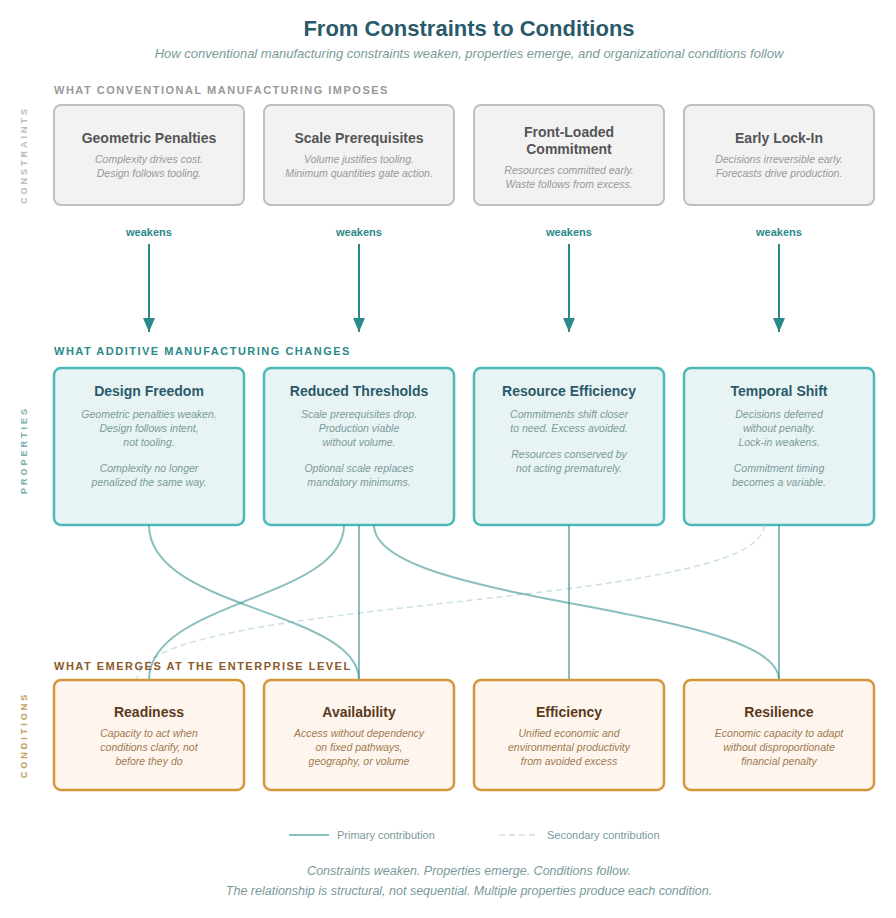
The framework basis is a straightforward causal idea. Conventional manufacturing imposes a set of long-standing constraints. Complexity drives cost, so design follows the demands of tooling. Volume justifies production, so minimum quantities gate what gets made. Resources are committed early, so waste follows from producing in anticipation of need. Decisions lock in early, so forecasts drive everything downstream.
Additive manufacturing weakens those constraints—not selectively, and not as a marketing feature, but structurally. As each constraint loosens, a property emerges in its place. As those properties accumulate across an organization, a set of conditions follows at the level of the enterprise. And those properties and impacts emerge even when an organization fails to notice or act on the released or diminished constraints.
Constraints weaken • properties emerge • impacts follow
This relationship—and the principle that it is structural rather than sequential, not a set of steps an organization progresses through but a logic that holds all at once—is the core claim of the entire framework.
The four Foundational Properties
The properties are the changes additive manufacturing makes—each loosening a constraint imposed by conventional manufacturing.
Design Freedom — the change in how geometry behaves. When complexity no longer carries a manufacturing penalty, design can follow function rather than the limits of tooling or processes.
Reduced Thresholds — the change in the economics of commitment. When production no longer requires the volume that once justified it, production becomes viable without committing to scale.
Resource Efficiency — the change in how resources, capital, and risk are allocated. When commitment can move closer to actual need—geographically or temporally—resources are conserved by not being committed prematurely.
Temporal Shift — the change in the timing of irreversible decisions. When commitment can be deferred without penalty, the lock-ins of design and volume that forecasts once imposed weaken.
One caution runs through the whole framework: these properties are neutral. They describe what changes, not whether the change is good. The same lowered barrier that lets an equipment operator to produce a discontinued part also lets a part be copied around the company that designed it and holds the intellectual property rights. The framework names this plainly rather than glossing over it.
The four Strategic Impacts
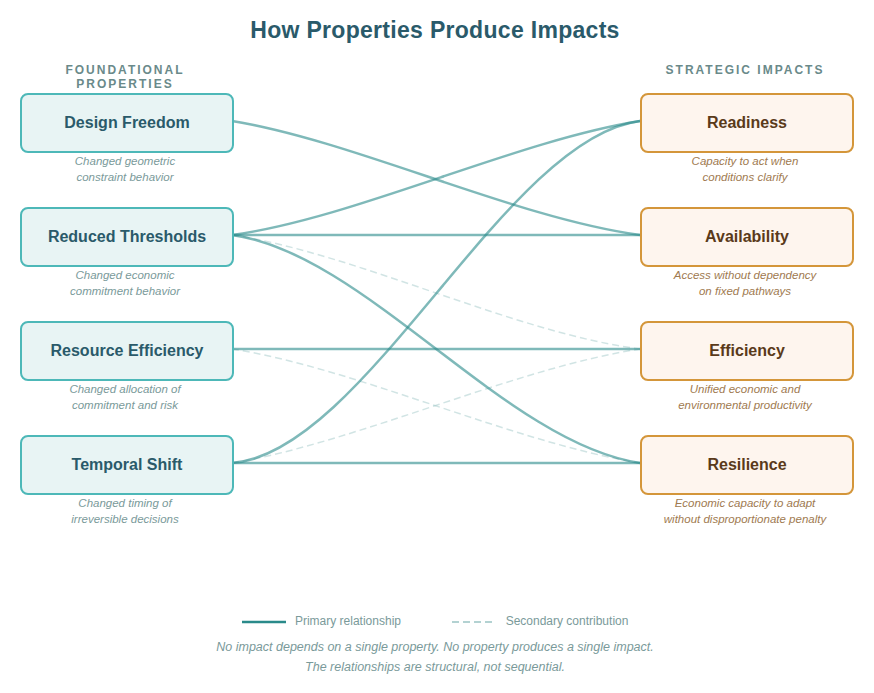
The impacts are the conditions the properties produce—emerging at the enterprise level as those properties accumulate.
Readiness — the capacity to act when conditions become clear, rather than committing resources ahead of that clarity.
Availability — access to production where and when it is needed, rather than being locked into a fixed supply route, location, or large production runs.
Efficiency — greater productivity from the resources committed, with less lost to excess, lowering cost and environmental impact together.
Resilience — the economic capacity to adapt and act when circumstances change, without paying a disproportionate price for inaccurate forecasts.
These are not goals an organization pursues one at a time. They follow from the properties—and the properties are intrinsic to additive manufacturing, not options an organization selects.
How they fit together
It would be simple if each property produced one impact. That is not the reality. The relationship is many-to-many: every impact draws on more than one property, and every property contributes to more than one impact. Readiness, for instance, comes mostly from Temporal Shift and Reduced Thresholds working together; Efficiency draws on Resource Efficiency but also on the excess avoided when production waits for demand. This overlap isn’t vagueness or conditionality. It is how the technology behaves inside an organization, where a single structural change ripples outward along several paths at once.
What it’s for, and where to go from here
The framework is built for anyone trying to understand additive manufacturing as more than a set of tools, and it meets different readers at different levels. Those already fluent in additive manufacturing recognize it in the properties—the changes they work with directly, now named and connected. Those who weigh capital, risk, and organizational capability recognize it in the impacts. Because the framework links the two, it gives the technically fluent the terms to make their case inside an organization, and gives those who decide a way to see where the value originates and why conventional measures so often miss it.
If this guide has provided the shape of the argument, the full framework offers the rest—each property and impact examined in depth, the boundaries where the claims no longer hold, and the questions the framework raises about its own limits. There is no single correct way in. Some readers start at the beginning; others start with the property they know best or the impact that matters most to them, and follow the connections from there. It is built to be entered from more than one direction.
Continue into the full framework: Why Commercial 3D Printing Needs a Strategic Frame →
Or choose from 3 reading paths based on orientation: Home →
THE FULL FRAMEWORK
The complete Strategic Impacts™ Framework—the Foundational Properties and Strategic Impacts examined in full, with their boundaries and open questions—is available at sherrimonroe.com.
Suggested citationMonroe, Sherri. The Strategic Impacts™ Framework: Foundational Properties and Strategic Impacts of Additive Manufacturing. sherrimonroe.com, 2026.