
The contrast is visible in how organizations deploy these capabilities.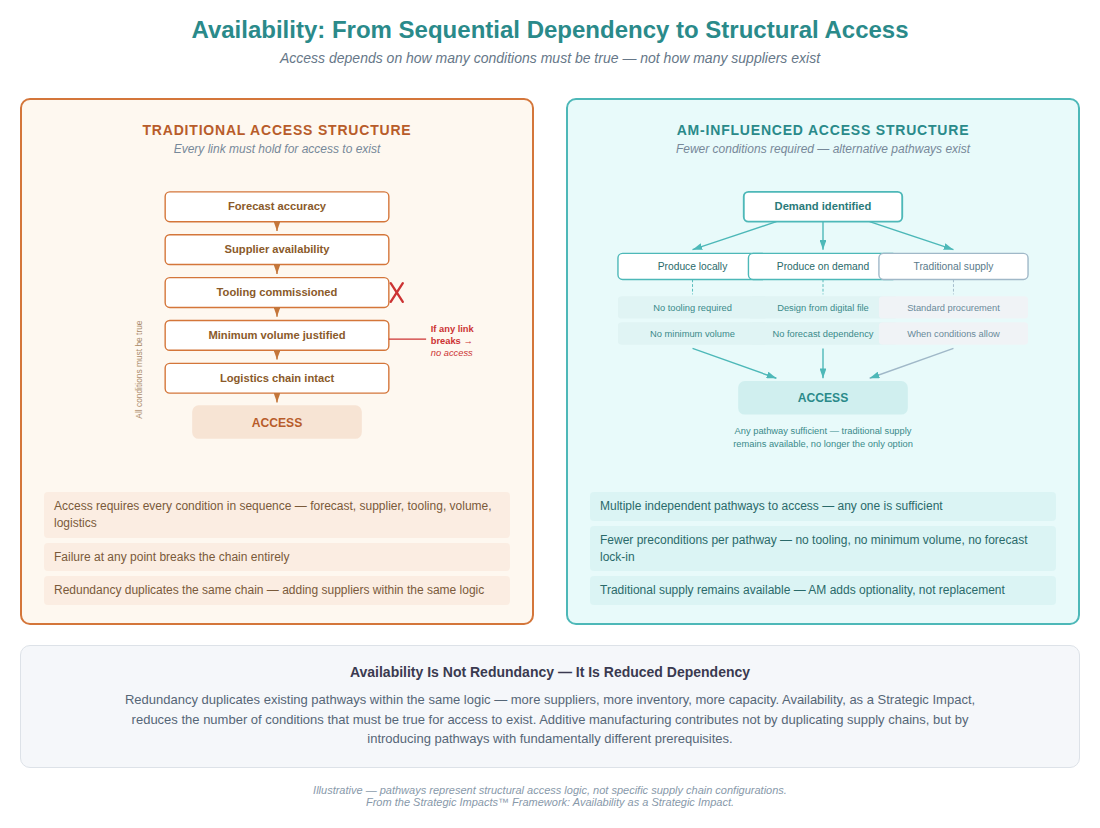
How dependency shifts when availability becomes structural
Organizations may maintain qualified additive processes capable of producing certain components, yet continue to rely almost exclusively on traditional suppliers for availability planning. Additive manufacturing is reserved for exceptions—short runs, urgent replacements, or low-volume spares. In these cases, access remains contingent on the same upstream assumptions: forecast accuracy, supplier continuity, and logistical reliability.
In contrast, organizations that regard additive manufacturing as an availability capability integrate it into baseline access logic. The question shifts. Not how quickly a supplier can deliver—but where production authority resides and how easily it can be exercised. Availability is evaluated not in terms of lead time, but in terms of dependency.
The difference is not technological. It is interpretive.
Availability Beyond Logistics
When additive manufacturing is regarded tactically, it is positioned as a fallback: a way to produce parts when traditional pathways fail. In this role, it is episodic and reactive. In these periods of disruption, additive manufacturing is assigned a difficult task and, even when successful, is viewed as an exception rather than revealing something important. Its value appears and then recedes once stability returns.
When regarded strategically, additive manufacturing influences availability continuously. It reduces reliance on fixed pathways and enables access without requiring the same preconditions. Availability becomes a standing capability rather than an emergency response.
This explains why additive manufacturing’s impact on availability varies so widely between organizations.
Availability Is Not Redundancy
When availability is misunderstood, additive manufacturing strategies often emphasize responsiveness rather than access. Metrics focus on turnaround time or emergency capacity. These measures capture performance under stress, but they do not address whether access depends on fragile assumptions.
This misunderstanding also affects who owns the decision. Availability is frequently managed within procurement or supply chain functions, even though its implications extend to risk exposure and strategic optionality
Availability is distinct from resilience, though the two are often linked.
Resilience describes economic capacity to adapt when conditions change. Availability describes whether access exists without requiring change in the first place.
Organizations that internalize this distinction begin to use additive manufacturing differently. They evaluate where access must be required regardless of demand predictability. Availability becomes something that can be designed, not merely defended.
Availability, when positioned as strategy, not reaction, shifts additive manufacturing from an alternative supplier to an alternative logic of access.