Strategic Impacts™ Framework > Foundational Properties: System Level > Article 3 of 5
Part of the Strategic Impacts™ Framework Series by Sherri Monroe
New to this work? Begin with the The Strategic Impacts Framework: An Introduction | Reader’s Guide
Series Progress ●●●○○
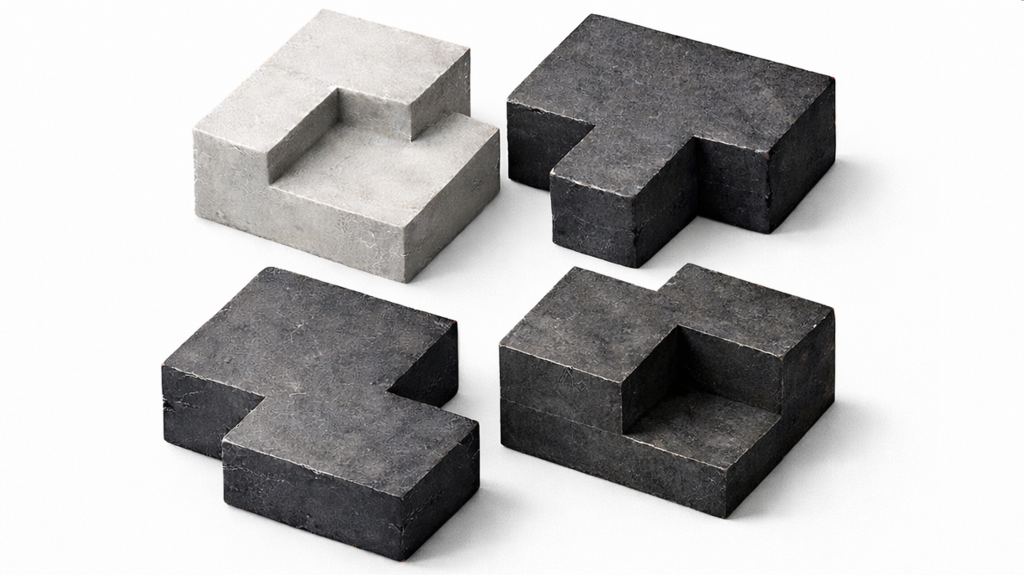
Design Freedom at the System Level
Why Additive Manufacturing Changes How Design Decisions Are Made
By Sherri Monroe
~5 min read | March 2026
Design freedom is one of the most frequently cited and displayed advantages of additive manufacturing. It appears in nearly every introductory discussion, often illustrated through complex geometries, internal channels, lattice structures, organic features, or part consolidation.
While those examples are real and valuable, they are not the most important consequence of design freedom.
There is a common refrain in additive manufacturing that the technology defeats physics—that it enables geometries that were previously impossible.
In most cases, the geometries were never physically impossible. They were economically impossible. The constraint was not what could be shaped, but what could be justified.
Additive manufacturing did not change what physics allows. It changed what economics allows.
The foundational shift was not aesthetic or even geometric. It was structural. Additive manufacturing altered the relationship between design intent and manufacturing constraint—and in doing so, changed how design decisions are made in the first place.
This article explores design freedom not as a capability to be exploited, but as a system property that emerges from the way additive manufacturing produces parts.
Design freedom becomes actionable not only because geometric penalties are reduced, but because design decisions do not need to be finalized as early.
Geometry can remain fluid longer because the penalties associated with late changes are lower.
This temporal flexibility is governed by the foundational property of Temporal Shift, which allows design intent to evolve closer to production without disproportionate cost or disruption.
At the production level, Design Freedom appears as changed geometric constraint behavior. Which constraints dominate design decisions shifts fundamentally. At the system level, its effects are less visible but more consequential. These effects are distributed across decisions, organizational assumptions, and entire supply chains—not just in individual components.
Design freedom is not the absence of constraints
In conventional manufacturing, design is inseparable from constraint. Tooling access, draft angles, parting lines, setup sequences, and yield risk all shape what is reasonable to produce. These constraints are embedded in the economics and physics of the production system, and they are not incidental.
Design effort in these environments is oriented toward simplification. Geometry is reduced, features are separated into assemblies, and performance is often traded for manufacturability. Over time, this logic becomes normalized. Good design comes to mean easier to make.
Additive manufacturing did not eliminate constraints. It changed which constraints mattered.
Additive manufacturing’s layer-by-layer production weakens many of the penalties associated with geometric complexity. Part and assembly features that would otherwise require multiple tools, setups, or assemblies can often be produced in a single build. As a result, the cost of complexity behaves differently—sometimes dramatically so.
Complexity is not free but it is no longer punished in the same way.
Why design freedom doesn’t scale proportionally
One of the consistent frustrations among additive manufacturing providers is that customers often underutilize design freedom. Parts are redesigned conservatively, or not redesigned at all, and the expected value never fully materializes.
This is often seen as an education problem or lack of understanding. In reality, it is a system interaction problem.
Design freedom in additive manufacturing is not incremental, and it is non-linear. Small changes in geometry can unlock disproportionate gains when they remove unneeded material, eliminate assemblies, remove secondary operations, or enable integrated performance features. In contrast, modest design changes may yield little benefit if they do not interact meaningfully with the production system.
This is why design freedom cannot be reduced to a checklist of features. Its value depends on how design intent, production constraints, and system economics intersect.
That intersection is difficult to see when additive manufacturing is evaluated through the lens of conventional manufacturing optimization.
Design freedom and reduced production thresholds are linked
Design freedom is inseparable from the other Foundational Properties. In particular, it is tightly coupled to reduced thresholds.
In conventional systems, design innovation is often gated by volume. Tooling investment must be justified. Risk must be amortized. Design exploration is constrained by the cost of committing too early.
Additive manufacturing weakens that gate.
When production thresholds are lower, design intent can be acted upon without first proving demand at scale. Iteration becomes viable. Integration becomes defensible. Performance improvements no longer need to be justified across thousands or millions of units.
In this context, design freedom is about what can be justified and decided, not what can be shaped.
Why design freedom is often misunderstood
Design freedom is frequently positioned as an invitation to over-engineer. Complex geometries are pursued because they are possible, not because they are necessary. When cost or qualification challenges follow, the conclusion is that additive manufacturing promised more than it could deliver.
This misinterpretation comes from positioning design freedom as a feature to maximize rather than as a property to navigate.
Additive manufacturing does not demand complex design. It allows design intent to be driven by performance, integration, and lifecycle considerations instead of manufacturing simplification alone. In many cases, the most valuable outcome of design freedom is not complexity—it is appropriateness.
That distinction is easy to miss when success is measured primarily by geometric novelty or visual difference.
Implications for technology providers
Design freedom is often assumed to create value automatically. In practice, it is a system property that requires alignment across design, production, and use context. Without that alignment, the value remains theoretical and ripe for perceived over promise and under delivery.
This alignment has practical implications.
Technology roadmaps that emphasize geometric capability without addressing decision economics risk overselling complexity. Software tools that expose freedom without helping users understand when it matters risk frustration. Materials positioned solely around printability rather than performance integration risk becoming interchangeable—competing on price alone rather than on the value they enable.
Conversely, providers that help customers understand when design freedom changes outcomes—not just how to use it—are better positioned to create durable value.
This is not a messaging problem. It is a framing problem.
Preserving the foundation
Design freedom was not additive manufacturing’s promise. It was its consequence.
By altering how manufacturing constraints behave, additive manufacturing changed the relationship between design intent and production reality.
That change made new decisions possible—sometimes subtle, sometimes transformative—but always grounded in system behavior rather than stylistic freedom.
Understanding design freedom as a system property does not limit its potential. It clarifies where it matters, why it behaves unevenly, and how it connects to the broader logic that made additive manufacturing disruptive in the first place.
That clarity is essential if design freedom is to be used deliberately rather than defended rhetorically.
Terms Used in This Article
- Design Freedom — changed geometric and design constraints
- Reduced Thresholds — closely coupled; geometric freedom depends on threshold reduction
- Availability — the primary impact Design Freedom manifests as at enterprise level