
Strategic Impacts™ Framework > Start Here > Making Sense of What We Already See
Making Sense of What We Already See
~6 min read | March 2026
Additive manufacturing has long been explained one application at a time, which shows what it can make but not what changes when an organization adopts it. The Strategic Impacts™ Framework supplies the missing structure—but a structure is only useful if what is already known can be seen and recognized. This article lays the framework over the familiar landscape of additive manufacturing, so its patterns read less as a new claim than as a name for what has already been seen.
What this work is doing
This work introduces a conceptual framework for understanding additive manufacturing. A framework that organizes additive manufacturing’s consistent behavioral patterns—beyond features and benefits—into a coherent explanatory structure at the production and enterprise level simultaneously.
There are existing process taxonomies, application catalogs, maturity models, adoption roadmaps, and use case libraries. None of these answer—or even raise—the questions this work addresses: why do the same patterns recur, and what do they mean for organizations that move beyond isolated adoption?
Throughout this work, additive manufacturing is described in terms of behavior rather than features, external actions, outcomes, or applications. Behavior, as used here, refers to the structural patterns that emerge consistently—how the system itself operates when additive manufacturing is present. These patterns are not chosen or optimized. They are properties of the system itself. Behavior implies agency without intention.
A river behaves—it erodes banks, follows gravity, carries and deposits sediment—not because it decides to, but because of what it is structurally and indifferent to whether the consequences are beneficial or measured.
Throughout this work, additive manufacturing’s effects are described primarily in terms of what changes structurally — constraints that weaken, thresholds that drop, commitments that shift. What is less often stated but always implied is the corollary: every constraint that loosens creates capacity that did not exist before.
Capital not locked in inventory is capital available for investment.
Decisions not forced early are decisions that can respond to better information.
Production not gated by volume is production that can serve markets previously dismissed as uneconomic.
The framework names the structural changes. The opportunities they create will differ by organization, industry, and strategy.
Rather than adding to the catalog of examples, it asks a different question:
Why do the same patterns appearing repeatedly, even as technologies, industries, and applications change?
Why does additive manufacturing appear in low-volume environments, in spare and legacy part contexts, in situations where timing and location matter more than unit cost, and in resilience and sustainability discussions—yet resist coherent discussion at the enterprise level?
These are not coincidences. They are not the result of clever applications alone.
They are signals of something structural.
This work examines those signals directly:
What additive manufacturing makes possible
What additive manufacturing changes structurally
What emerges when those changes accumulate across an organization
By making these distinctions, the framework provides a way to move beyond—without dismissing—valuable use case examples, to explain why familiar outcomes are structural rather than situational, and why their implications often extend far beyond the parts and processes that made them visible.
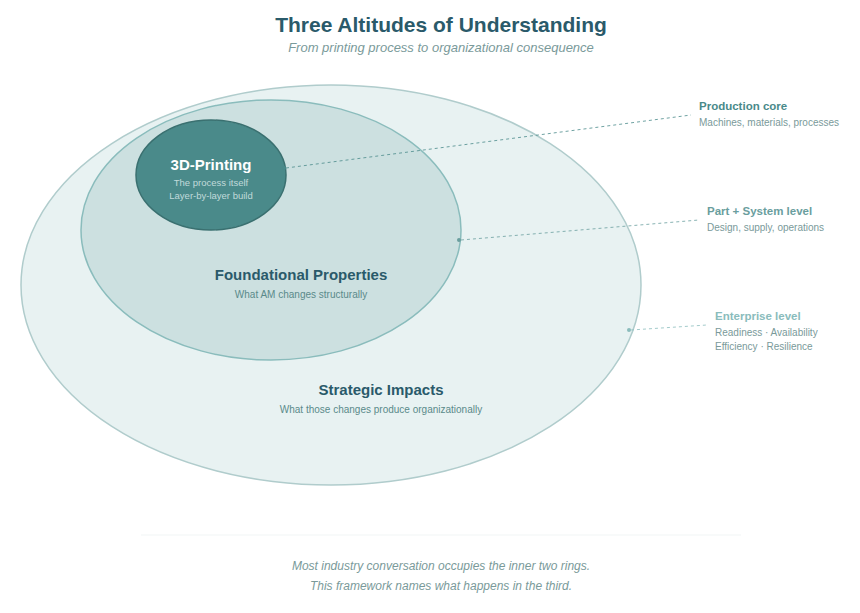
The concentric view above shows the shift in distance—a shift from process, to structural change, to organizational consequence. The diagram below maps that same structure to the framework’s actual architecture: four Foundational Properties examined at two levels, and four Strategic Impacts that emerge at the enterprise level.
From accumulation to explanation
The additive manufacturing sector is rich in technical knowledge.
Machines, materials, processes, and applications have been explored in depth. Entire organizations have built expertise and businesses around advancing and deploying these capabilities. None of that is in question.
What has remained implicit is the underlying logic at play that connects the outcomes driven by these advances—a way to explain additive manufacturing as a manufacturing system with distinct behaviors, not simply as a set of tools.
Without that structure, additive manufacturing is adopted tactically rather than strategically, sustainability discussions remain fragmented, resilience appears episodic, and executive conversations return to use cases instead of fundamentals.
This work does not attempt to resolve those challenges through advocacy.
It resolves them through clarity.
These properties—Design Freedom, Reduced Thresholds, Resource Efficiency, and Temporal Shift—are not benefits or features. They describe what additive manufacturing changes. These effects are the most immediately visible and the easiest to recognize from direct manufacturing experience. While these labels may feel familiar, the way they are examined is likely new.
Why this lens emerged
This work emerged from a perspective shaped outside the additive manufacturing industry itself. The lens applied here was informed by experience in business strategy, technology development, and innovation working with organizations developing new technologies and adopting them.
What stood out was not a lack of capability but a lack of language and explanation. Impressive examples were easy to find and impressive to show. But attempts to describe additive manufacturing without relying on use cases or dense, eye-glazing technical detail consistently fell short. Over time, it became clear that the issue was not advocacy or maturity, it was not capability or demonstration, but framing.
Something structural was happening—and it was largely unnamed.
Why this approach is intentionally restrained
This work resists simplification by design.
Additive manufacturing has matured beyond the point where persuasion and enthusiasm are the limiting factors.
The objective here is to name, not convince.
The objective is to make explicit what has been implicit—what has been visible all along, but rarely articulated as structure. To provide language precise enough to support serious and thoughtful discussion without collapsing into promotion or prescription.
If this work succeeds, it will feel less like a revelation than a recognition.
How to read what follows
Each article can be read on its own.
Read together, they form a coherent explanation.
This is not a fast read. It is a clarifying one.
What follows does not ask you to agree with a conclusion. It asks you to examine whether the framework explains what you already see—and whether it does so more cleanly than the narratives that have come before.
Read Next: A Reader’s Guide to This Body of Work