By making these distinctions, the framework provides a way to move beyond, without dismissing, valuable use case examples to explain why familiar outcomes recur, and why their implications often extend far beyond the parts and processes that made them visible.
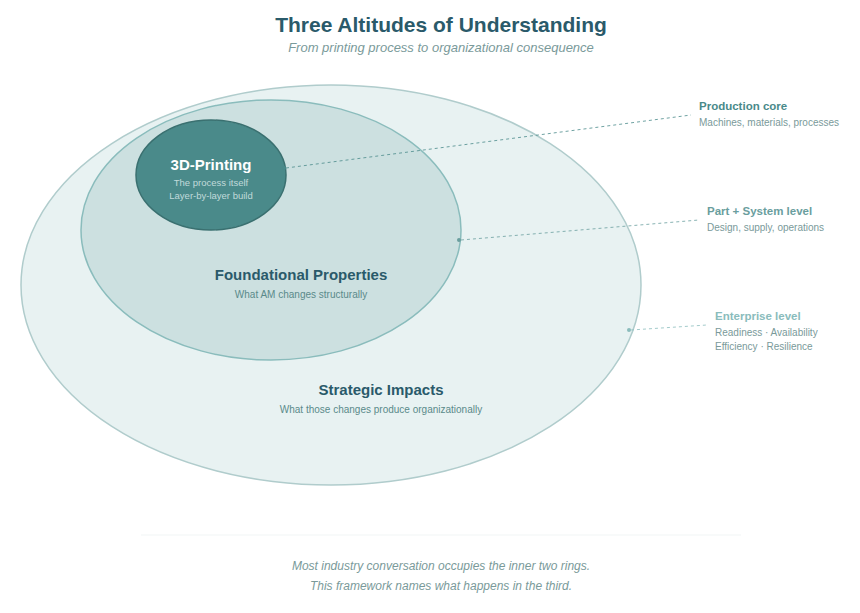
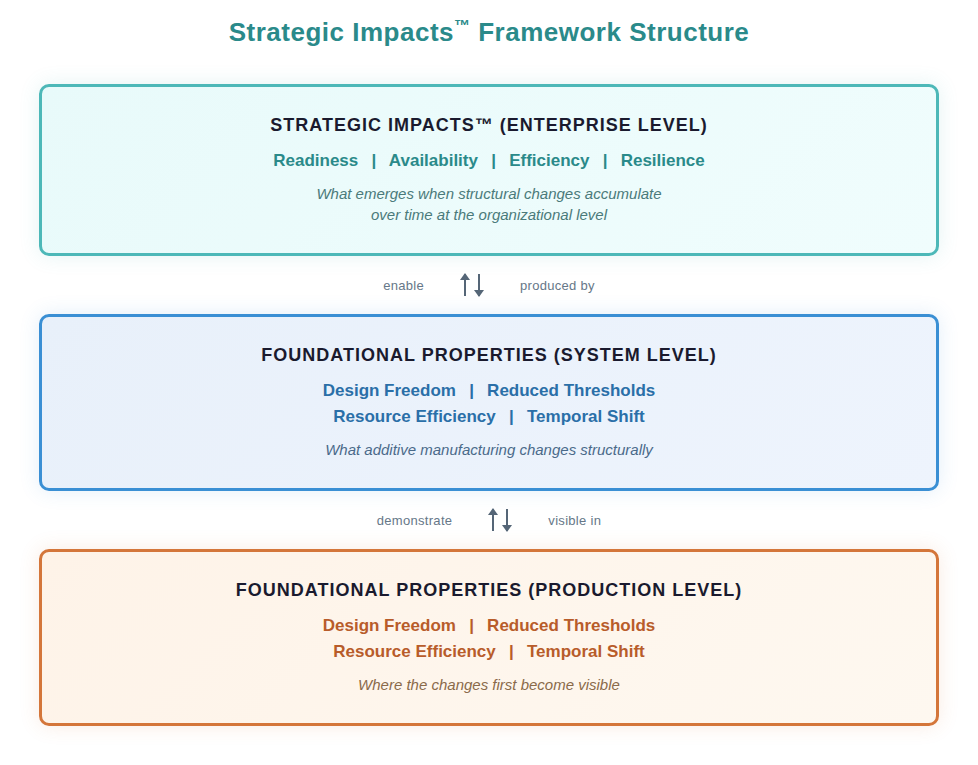
The concentric view above shows the shift in distance—a shift from process, to structural change, to organizational consequence. The diagram below maps that same structure to the framework’s actual architecture: four Foundational Properties examined at two levels, and four Strategic Impacts that emerge at the enterprise level.
From accumulation to explanation
The additive manufacturing sector is rich in technical knowledge.
Machines, materials, processes, and applications have been explored in depth. Entire organizations have built expertise and businesses around advancing and deploying these capabilities. None of that is in question.
What has remained implicit is the underlying logic at play that connects the outcomes driven by these advances—a way to explain additive manufacturing as a manufacturing system with distinct behaviors, not simply as a set of tools.
Without that structure, additive manufacturing is adopted tactically rather than strategically, sustainability discussions remain fragmented, resilience appears episodic, and executive conversations return to use cases instead of fundamentals.
This work does not attempt to resolve those challenges through advocacy.
It resolves them through clarity.
How this body of work is organized
The articles that follow are organized deliberately.
The first series introduces the Foundational Properties of Additive Manufacturing at the production level, exploring and defining how four structural properties show up in parts, components, and production decisions. These properties—Design Freedom, Reduced Thresholds, Resource Efficiency, and Temporal Shift—are not benefits or features. They describe what additive manufacturing changes. These effects are the most immediately visible and the easiest to recognize from direct manufacturing experience. While these labels may feel familiar, the way they are examined is likely new.
The second series examines those same four properties from a wider, zoomed-out distance, at the system and enterprise level. From this vantage point their effects are less tangible but more consequential.
Neither of these series depends on the other. Both describe the same underlying structure from different distances with different levels of organizational consequence.
The body of work moves through five layers — contextual, reference, foundational properties at the production and system levels, and strategic impacts. Each layer builds on the one before. They do not argue for adoption. Together they explain behavior. The Reader’s Guide provides structure and reading guidance.
Why this lens emerged
This work emerged from a perspective shaped outside the additive manufacturing industry itself. The lens applied here was informed by experience in business strategy, technology development, and innovation working with organizations developing new technologies and adopting them. That adoption and integration changed how decisions were made, not just how old work streams were replaced and work was executed. Exposure to manufacturing was indirect but the focus was organizational rather than technical.
What stood out was not a lack of capability but a lack of language. Impressive examples were easy to find and impressive to show. Explanations that accounted for why those examples kept recurring—across industries, applications, and organizational conditions—were not. Attempts to describe additive manufacturing without relying on use cases or dense, eye-glazing technical detail consistently fell short. Over time, it became clear that the issue was not advocacy or maturity, it was not capability or demonstration, but framing.
Something structural was happening—and it was largely unnamed.
Why this approach is intentionally restrained
This work resists simplification by design.
Additive manufacturing has matured beyond the point where persuasion and enthusiasm are the limiting factors. What limits understanding now is the absence of a shared way to interpret what the collective technology—across materials and processes, applications, and sectors—actually changes once it becomes part of how organizations prepare, supply, and operate.
The objective is to name, not convince.
The objective is to make explicit what has been implicit—what has been visible all along, but rarely articulated as structure. To provide language precise enough to support serious and thoughtful discussion without collapsing into promotion or prescription.
If this work succeeds, it will feel less like a revelation than a recognition.
How to read what follows
Each article can be read on its own.
Read together, they form a coherent explanation.
This is not a fast read. It is a clarifying one.
What follows does not ask you to agree with a conclusion. It asks you to examine whether the framework explains what you already see—and whether it does so more cleanly than the narratives that have come before.