
Reduced thresholds weaken this linkage and pressure. When production is viable without tooling amortization across high volumes, components can be designed for their specific context—matched to the product, the user, the operating condition, market variability. The constraint that forced lowest-common-denominator design was never a design decision. It was an economic one. When the economics change, so does the design logic.
Low volume is a constraint. Optional scale is a condition.
Even when the total requirement is large, volume is the outcome of the production equation—not an input to it. Ten thousand parts over three years does not require ten thousand parts produced at once and stored. It requires a production system capable of responding as need materializes—across time, location, and design variation.
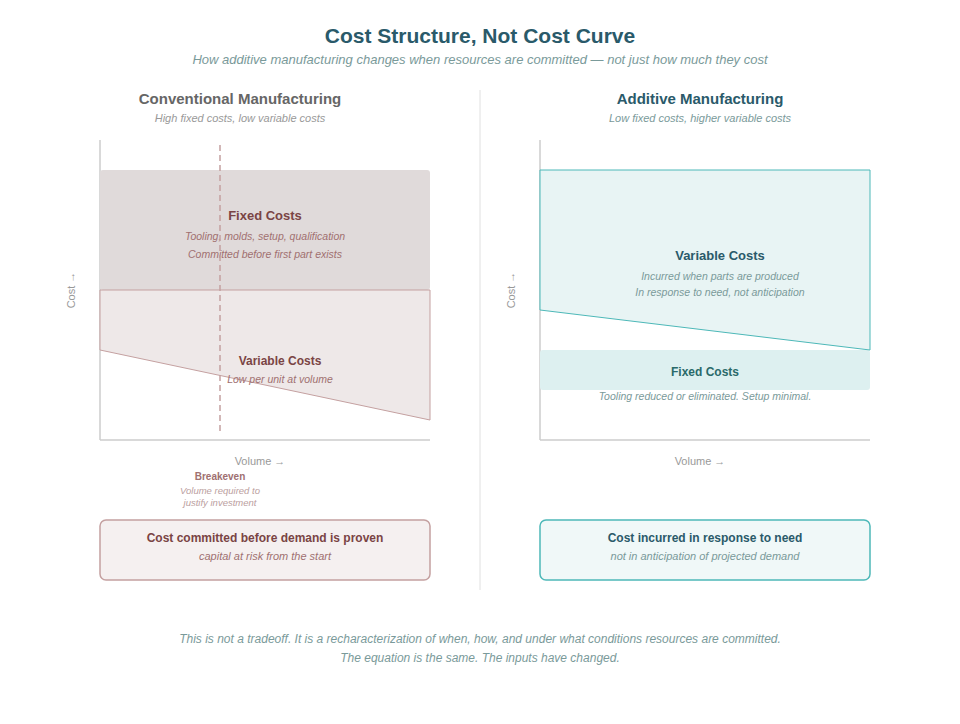
Fixed-to-variable cost structure: conventional vs. additive manufacturing
Why This Property Is Often Misunderstood
Additive manufacturing is frequently evaluated using part-to-part cost comparisons that assume scale is the primary determining factor of viability. Using that lens, reduced thresholds appear as a weakness rather than a structural advantage.
When the question being asked is, “How does this perform at high volume?” the answer will, and has, often disappointed.
But reduced thresholds explain why additive manufacturing appears repeatedly in contexts where scale is uncertain, fragmented, or undesirable—including spare, service, and legacy parts, contingency production, and volatile demand environments.
The technology is not failing to scale. It is operating under a different viability condition.
Many of the goals the additive manufacturing industry has set for itself—cost-per-part parity, high-volume throughput, utilization rates comparable to conventional equipment—are not manufacturing achievements. They are conventional manufacturing’s constraints, reframed as targets.
The goals were never neutral. They are the old system’s constraints dressed as universal standards.
Scale, speed, and unit cost became dominant metrics because they are what conventional tooling-driven economics demand. Pursuing those same metrics as additive manufacturing goals imposes the logic of the system additive manufacturing structurally changes. The question is not whether additive manufacturing can match conventional manufacturing on conventional terms. It is whether those terms, measurement models, and standards remain the right ones when the underlying constraint behavior is different.
Reduced Thresholds and the Role of Time
Reduced thresholds explain why production can make sense without scale.
On their own, reduced thresholds do not explain when production should occur or how timing decisions change. The ability to delay commitment, produce closer to need, or distribute production over time is governed by a separate foundational property: Temporal Shift.
Reduced thresholds make action possible.
Temporal shift determines when that action becomes viable.
Keeping these properties distinct clarifies why additive manufacturing behaves differently without collapsing multiple effects into a single explanation.
What Reduced Thresholds Do—and Do Not—Explain
Reduced thresholds do not guarantee economic advantage in every scenario. And they do not eliminate cost considerations, capacity limits, or planning discipline.
Reduced thresholds explain why production can occur without the conventional preconditions of scale, aggregation, and early commitment.
They clarify why additive manufacturing can function where conventional manufacturing struggles—not because it is cheaper at volume, but because it does not require volume to begin.
This is not a strategy. It is a structural condition.
Why Reduced Thresholds Matter
Without this property clearly examined and articulated, additive manufacturing is often mischaracterized as inefficient, immature, uneconomic, and unsustainable. Its strengths are measured, sometimes overlooked, and evaluated using metrics designed for systems with fundamentally different constraint behavior.
Reduced thresholds provide a more accurate lens. They explain why additive manufacturing consistently shows value in environments shaped by uncertainty, variability, and risk—and why those patterns recur across industries and applications.
Reduced thresholds do not sell additive manufacturing. They explain when production makes sense.
From Reduced Thresholds to Economic Resilience
Reduced Thresholds do not only change operational viability—they change economic structure.
When production becomes viable at lower volumes without proportional tooling investment, less capital must be committed before action makes sense. This creates more than just access to low-volume production (Availability). It creates economic adaptability and flexibility (Resilience).
Reduced Thresholds enable access to production without volume prerequisites. That access is Availability. Resilience is something different: the economic capacity to adapt when conditions change, without disproportionate financial penalty.
Conventional manufacturing locks capital into early commitments. Tooling to commission and often ship long distances. Setup costs to amortize. Supplier contracts to negotiate based on volume assumptions. Once capital is committed, it becomes sunk cost. When demand shifts, designs evolve, or strategies pivot, organizations face a choice: continue using what is no longer optimal or absorb significant financial loss to redirect.
Reduced Thresholds change this structure.
When less capital must be locked in before production becomes viable, organizations preserve financial flexibility. They can start smaller, test assumptions with lower exposure, and scale in response to actual demand rather than forecasts. The economic penalty for being wrong is structurally lower because less has been committed and spent.
This is Resilience as a Strategic Impact—and it emerges directly from how Reduced Thresholds change capital commitment patterns.
Three related but distinct outcomes
Three impacts emerge from the same threshold reduction:
Availability is supply access without volume constraints
Readiness is operational preparedness without premature commitment
Resilience is economic capacity to adapt without catastrophic loss
Organizations with mature additive manufacturing integration consistently report Resilience effects:
Less working capital locked in inventory — and more capital available for growth
Lower financial penalty from forecast errors — and greater willingness to enter uncertain markets
Greater ability to redirect resources when priorities shift — and faster pursuit of opportunities previously dismissed as uneconomic
Reduced exposure to demand volatility — and increased confidence in committing to new product lines, customer segments, or geographic markets.
These are not operational improvements. They are structural changes.
Changes in economic exposure that create strategic capacity—the organizational ability to act on opportunity, not just absorb disruption.
Resilience does not eliminate risk or uncertainty. It changes the financial magnitude of being wrong.