Strategic Impacts™ Framework > Foundational Properties: System Level > Article 1 of 5
Part of the Strategic Impacts™ Framework Series by Sherri Monroe
New to this work? Begin with the The Strategic Impacts Framework: An Introduction | Reader’s Guide
Series Progress ●○○○○
The Foundational Properties at a System Level
Why Additive Manufacturing Behaves Differently
By Sherri Monroe
~6 min read | March 2026
This article introduces the Foundational Properties of Additive Manufacturing as they operate at the system and enterprise level. Readers new to this framework may wish to begin with the Making Sense of What We Already See (Orientation) or the Production Lens series.
These four properties are independent and operate simultaneously. They are not steps, stages, or a sequence. The same properties are present regardless of process, material, scale, or application—what changes is the level at which their effects become visible. This series examines them where they surface first: in parts and production decisions.
The preceding series looked at four Foundational Properties where they are most visible and tangible: at both the part and production level.
Design Freedom as changed geometric constraints—lighter structures, consolidated assemblies, internal channels that conventional tooling cannot produce.
Reduced Thresholds as production viable at volumes not justified under conventional manufacturing economics
Resource Efficiency as material, energy, and capital consumed differently.
Temporal Shift as decisions made later and economic commitments deferred.
Individually, none of these is new to anyone working in additive manufacturing, although reduced thresholds and temporal shift are likely new names. The Production Lens series organized them, named them, and showed that they are not isolated benefits tied to specific applications. They are structural properties of the manufacturing system itself. The same patterns recur even when the part changes, the process changes, the industry changes, material changes, and production volume changes.
That recurrence is the signal this series takes seriously.
These properties explain, at the production level, why additive manufacturing repeatedly produces recognizable outcomes. They explain, at the system level, something different: why additive manufacturing changes how organizations design, supply, and operate—even when those changes are not explicitly pursued or even sensed.
The transition is not a change in subject. It is a change in distance.
Design freedom extends beyond individual parts and components. It influences how systems are architected. Reduced thresholds across portfolios reshape inventory, sourcing, and production strategy. Resource efficiency is structural rather than optimized. It alters capital allocation and risk. Temporal Shift reaches beyond prototyping to readiness and responsiveness.
These effects are not only visible at the part level. They emerge when the same properties operate across products and programs and time. At that point, additive manufacturing stops being a set of production choices and starts behaving like a systemic influence.
This series examines that influence.
The four properties do not change at the system level. What changes is where their effects become visible—and what they alter.
At the part level, the effects are visible and tangible: better components, faster cycles, fewer compromises. At the system level, they are organizational: how products are designed, how supply chains are structured, how risk is allocated, how decisions are timed.
Four Foundational Properties
- Design Freedom Changed geometric constraint behavior
In conventional manufacturing, geometry carries heavy penalties. Complexity drives tooling cost, setup time, and process risk. As a result, design decisions are more often shaped by manufacturability constraints and less by functional intent.
Additive manufacturing weakens many of those geometric penalties. Complexity is not “free,” but the constraints that dominate design decisions are changed. A broader range of geometries becomes viable earlier in the design process as a result.
Design freedom, in this sense, is not about complex shapes. It is about how constraint behavior changes, and how that change reshapes the very logic of design. - Reduced Thresholds Changed economic commitment behavior
In conventional manufacturing, production typically becomes viable only once volume justifies tooling, setup, and fixed costs. Consequently, scale is a prerequisite, not an option, and commitment must be made early.
Additive manufacturing lowers the threshold at which production can make sense. Tooling and setup barriers are reduced or eliminated, allowing production to occur without scale as the gating condition.
Reduced thresholds do not describe low volume as a goal. They describe optional scale—the ability to act without committing to design commonality, mass quantity, centralized production, or early volume assumptions.
This property explains why additive manufacturing appears repeatedly in spares, service parts, contingency production, and volatile demand environments.
- Resource Efficiency Changed allocation of commitment and risk
Resource efficiency in additive manufacturing is often discussed in terms of material consumption or energy use. Those effects are real, but they are secondary.
At a foundational level, resource efficiency emerges because fewer irreversible commitments are made prematurely. When production thresholds are reduced and design decisions can remain fluid longer, material, energy, capital, time, opportunity, and risk are conserved structurally.
Efficiency, in this context, is not about optimization. It is the result of avoiding unnecessary action—producing closer to need (where and when), committing later, and reducing overproduction, excess inventory, unnecessary distribution, and stranded capital.
- Temporal Shift Changed temporal commitment behavior
Time, in additive manufacturing, is often reduced to questions of speed: print time, cycle time, or lead time. Speed matters, but it is not the defining shift. Nor is it the objective it is often positioned as.
Additive manufacturing changes when decisions must be made and when commitments become irreversible. Designs can remain flexible longer. Production can happen closer to the moment of need. Manufacturing no longer has to happen all at once, in one place, of a single design, or far in advance.
This temporal shift explains why debates about print speed often miss the point. Once production no longer requires large volumes, centralized facilities, or everything made at once, the role of speed changes significantly. Responsiveness, availability, and timing become more important than raw throughput.
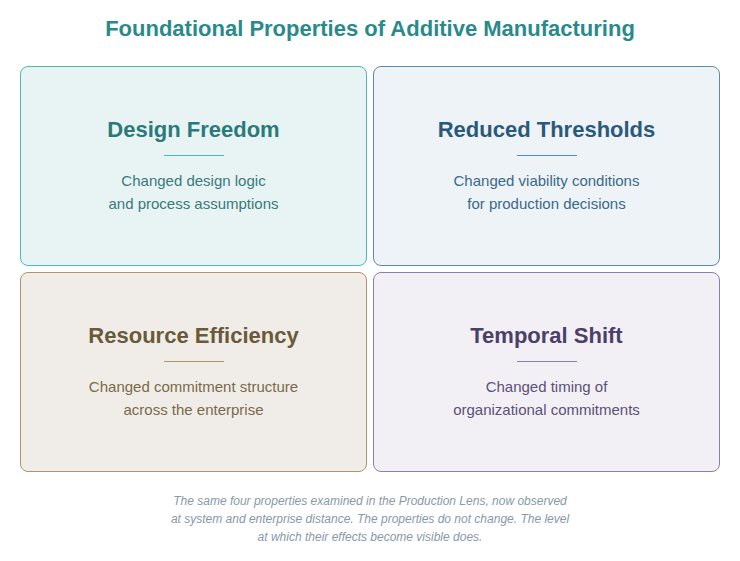
These are the same four properties introduced in the Production Lens series. At production level, their effects appear in parts—lighter components, consolidated assemblies, smaller production runs. At system level, those same properties appear in decisions—changed design assumptions, altered viability calculations, deferred commitments, restructured resource allocation. The properties have not changed. The distance has.
A System, Not a Sequence
These four properties are not steps, phases, or a maturity model. They cannot be pulled apart because they describe the same system from different constraint dimensions.
Design Freedom changes what decisions are viable
Reduced Thresholds change whether decisions must be justified by scale
Resource Efficiency changes how costly decisions are when made
Temporal Shift changes when decisions must be made
Together, they explain why additive manufacturing behaves differently. This framing also explains why additive manufacturing so often resists evaluation through conventional manufacturing measurement, logic, and standards.
The sequence in which these properties are introduced here differs from their sequence in the Production Lens series, and differs again from how they are mapped in the Strategic Impacts™ series. That variation is intentional and reflects the same logic this section describes.
At the system level, Reduced Thresholds and Temporal Shift emerge as the most structurally consequential properties—they govern if and when production can occur—so they anchor this series. They are also the two properties least likely to be familiar by these names, though their effects—optional scale, deferred commitment, on-demand production—are well known in practice.
At the production level, Design Freedom is introduced first because its effects are most visible and tangible to engineers and operators working with parts.
In the Strategic Impacts framework, the sequence reflects how properties connect to organizational realities rather than how they appear in design labs or on production floors.
Readers who encounter these properties in a different order have not encountered a contradiction. They have seen the same system from a different angle.
What These Properties Do (and Do Not) Explain
The Foundational Properties do not prescribe a strategy. They do not determine where additive manufacturing should be used or whether it will be successful. Instead, they explain the organizational conditions under which additive manufacturing operates.
Understanding these properties does not eliminate tradeoffs. It clarifies where those tradeoffs come from and why familiar metrics and comparisons often misfire.
This foundational layer is not an argument for adoption. It is an explanation of behavior.
Why This Clarity Matters
Much of the ongoing debate around additive manufacturing—about cost, scale, sustainability, and maturity—stems from the absence of a shared explanatory model. The Foundational Properties provide that missing layer.
They do not sell additive manufacturing. They explain it.
Terms Used in This Article
- Foundational Property — a persistent structural characteristic, not a feature or benefit
- Design Freedom — changed geometric and design constraints
- Reduced Thresholds — changed minimum commitments for production
- Resource Efficiency — changed patterns of resource commitment
- Temporal Shift — changed timing of decisions and commitments
- Condition — a state present in the organization, shaping decisions and capacity, whether or not it has been named or measured