This framework examines why additive manufacturing so often show up in low-volume or varying-demand environments, in spare and legacy parts, and in situations where timing and location matter more than unit cost—yet struggles to find a coherent, enterprise-level framing.
These are signals—not coincidences.
How the Framework Is Structured
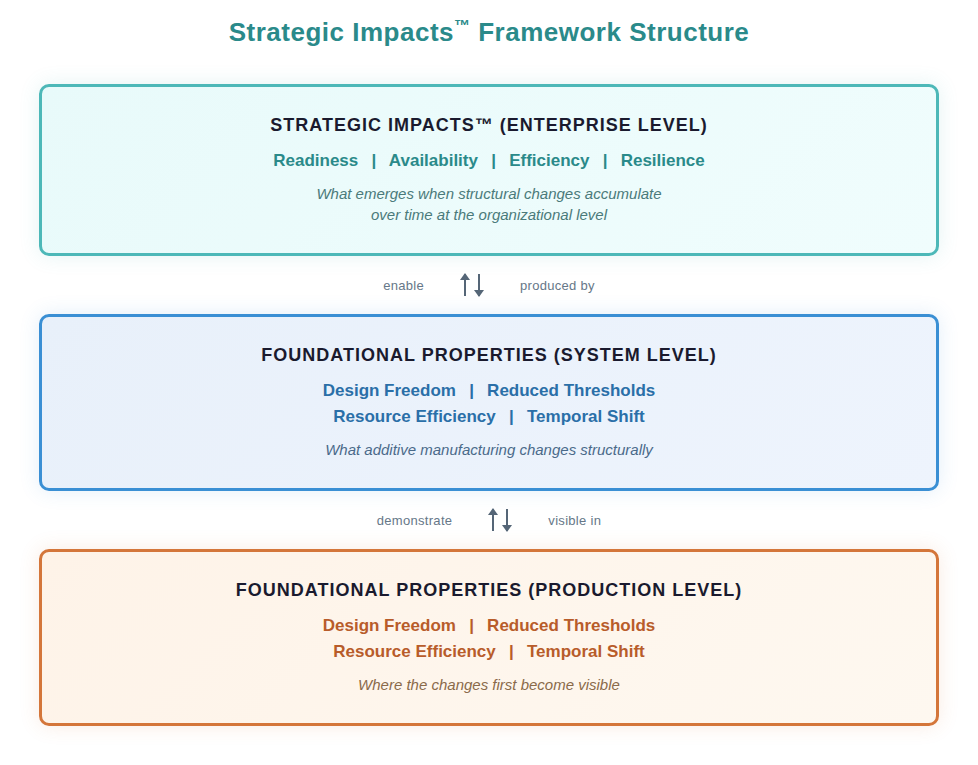
The Strategic Impacts™ Framework operates at three levels:
At the production level, four Foundational Properties describe what additive manufacturing changes structurally: Design Freedom, Reduced Thresholds, Resource Efficiency, and Temporal Shift. These properties explain why and how familiar outcomes occur repeatedly.
At the system level, those same four properties are viewed from a wider organizational distance, where their effects are less tangible but more consequential for how organizations design, supply and operate.
At the enterprise level, when those structural changes accumulate, they merge as four Strategic Impacts: Readiness, Availability, Efficiency, and Resilience. These are not benefits to be gained, but organizational conditions that emerge when additive manufacturing is integrated rather than exceptional.
This framework does not prescribe if or how additive manufacturing should be used, nor does it guarantee advantage. It does provide a lens for interpretation and understanding—a way to see additive manufacturing not as a set of disparate tools, but as an influence on organizational behavior.
What This Framework Is Not
This framework does not propose when or where additive manufacturing should be used. It does not offer a roadmap, checklists, or next steps. It does not attempt to prove value through use case studies or ROI comparisons.
Those are important conversations—and best served elsewhere. This framework operates at a different level. It explains behavior, not merit.
Who This Framework Is For
This framework is presented for manufacturing leaders, supply chain strategists, sustainability professionals, and policy stakeholders—anyone who needs to understand why additive manufacturing behaves differently from conventional manufacturing.
How to Read This Work
The framework can be entered at different points. See the Reader’s Guide for navigation options.
Readers focused on strategic implications may choose to go directly to the Strategic Impacts Series.
Why This Clarity Matters
Much of the ongoing debate around additive manufacturing—about cost, scale, sustainability, and maturity—comes from the absence of a shared explanatory model. Additive manufacturing is judged primarily by comparison, defended through examples, measured with misapplied models, and framed through outcomes rather than structure.
The Strategic Impacts Framework provides that missing layer. It offers a way to explain additive manufacturing succinctly, without hype, and without relying on case studies or exceptions.
It does not sell additive manufacturing – it explains it.